With a pitched roof you can choose between inside and outside. With a flat roof there is really no such choice: the insulation belongs on the outside, under the roof covering. Insulating the underside of a flat roof is almost always a bad idea in terms of building physics.
The reason is condensation. If you insulate under a flat roof, the roof deck above becomes cold while warm air can still reach it. Moisture then condenses in a place where it cannot dry out, and that damages the structure.
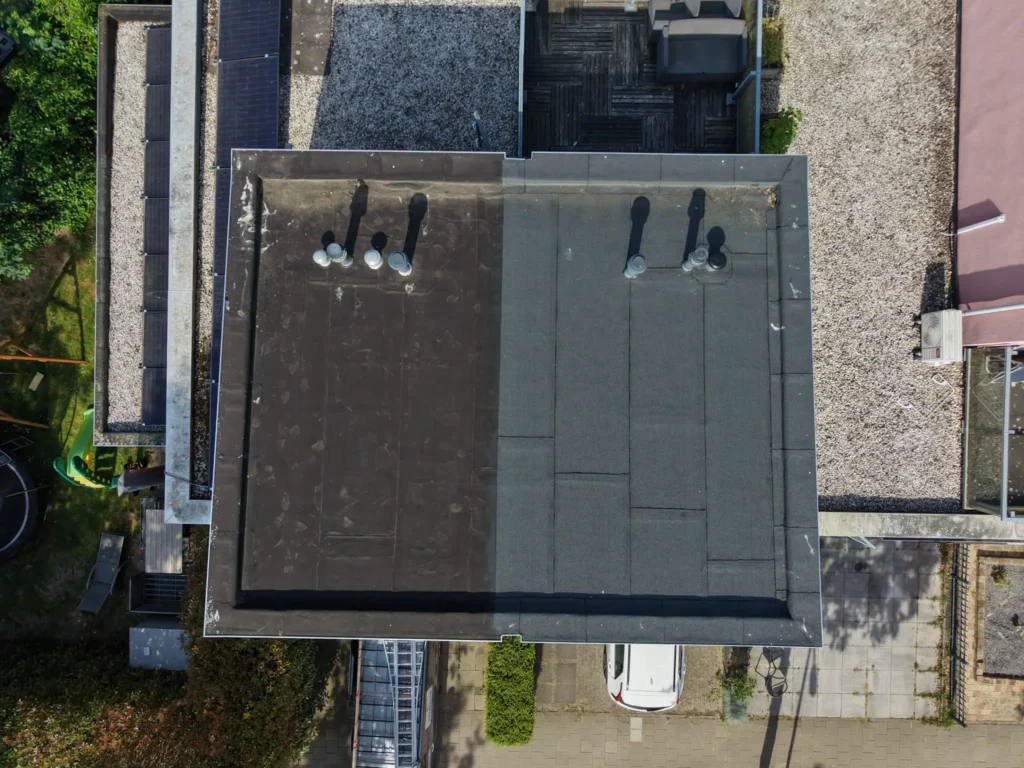
What the build-up looks like
The roof deck. Concrete, timber joists with boarding, or steel roof sheets. This is the structure that everything rests on, and it must be sound before anything goes on top.
The vapour control layer. Directly on the roof deck, to stop moisture from the house getting into the insulation. On a flat roof this layer is essential, because the insulation cannot dry out upwards.
The insulation. Rigid boards, usually PIR, in the thickness that gives the required insulation value. The fall can also be built into this layer using tapered boards.
The roof covering. Two layers of bitumen or EPDM, with the upstands, roof edges and penetrations neatly finished. See
bitumen or EPDM.
“On a flat roof you insulate from the outside. Insulating from the inside means making the structure cold and trapping the moisture.”
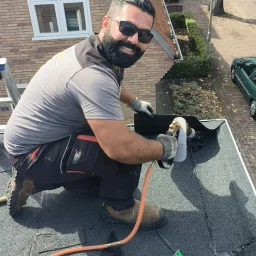
Fouad, owner of Astrodak Service
Why this belongs with a replacement
To put insulation on a flat roof, the covering has to come off. That happens to be the most expensive and labour-intensive part of the whole job. If you insulate separately from the replacement, you pay for stripping, removal and relaying twice.
That is why, with a flat roof that is twenty years old or more, the question is not really whether you will insulate, but whether you want to do it at the moment the roof is opened up anyway. And that is usually the only moment when it makes financial sense.
Insulating with replacement
once
stripping and removal
Insulating separately
twice
stripping and removal
What does insulating get you in your own house?
The benefit depends on the roof structure, the current insulation and how you use the space. I work it out for you in concrete terms during the inspection, including the grant you are entitled to.
Building the fall into the insulation
This is the underrated advantage of insulating on the outside. With tapered insulation boards you create the fall at the same time, so the water runs to the drain instead of standing in a low spot.
On a roof that has puddles now, this solves two problems in one go: the insulation and the reason the old roof aged so quickly. See
the fall on a flat roof.
What the regulations require
If you renew part of the roof, a minimum insulation value of Rc 1.3 m²K/W applies to that part. With a major renovation, where more than a quarter of the building envelope is renewed, the new-build requirement of Rc 6.3 m²K/W applies.
What happens to the height of the roof
Insulation makes your roof thicker, and that has consequences for the edges. The upstand against a wall has to be higher, the roof edge ends up higher, and the connection to a door or window that opens onto the roof can become tight. With an extension under an existing window, that is the first thing to measure.
This can usually be solved by adjusting the roof edge, and sometimes by using a thinner but better insulating material. What you do not want is insulation that eats up the upstand height, because then the water will come over the edge in a heavy downpour.
Frequently asked questions about insulating a flat roof