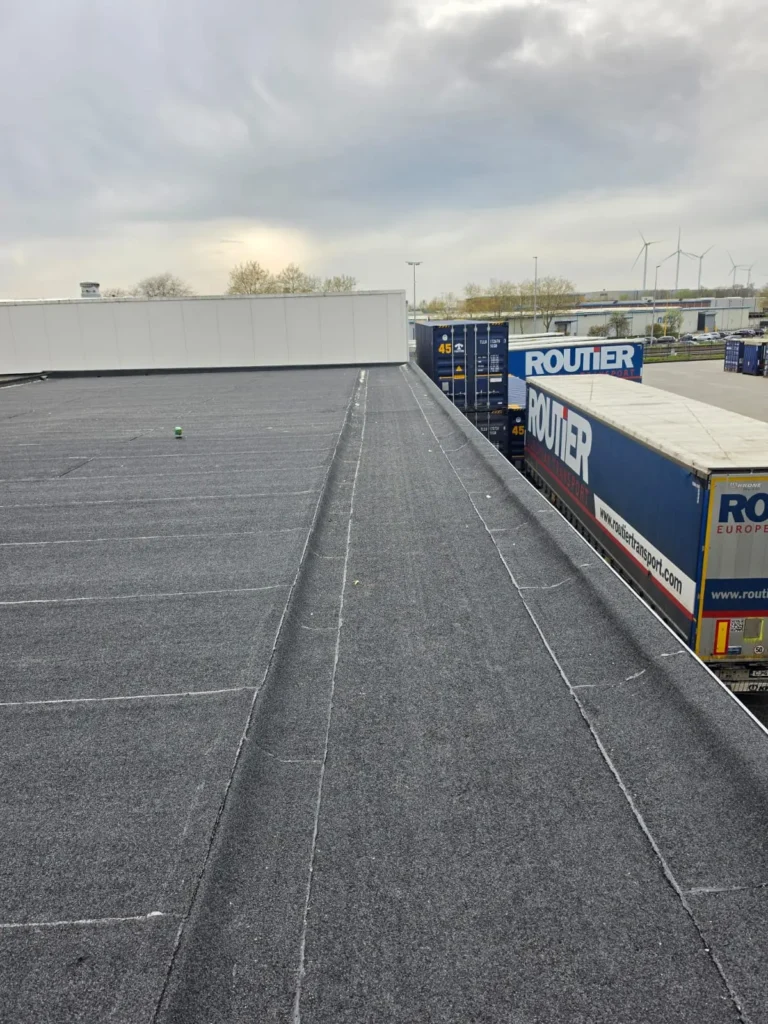
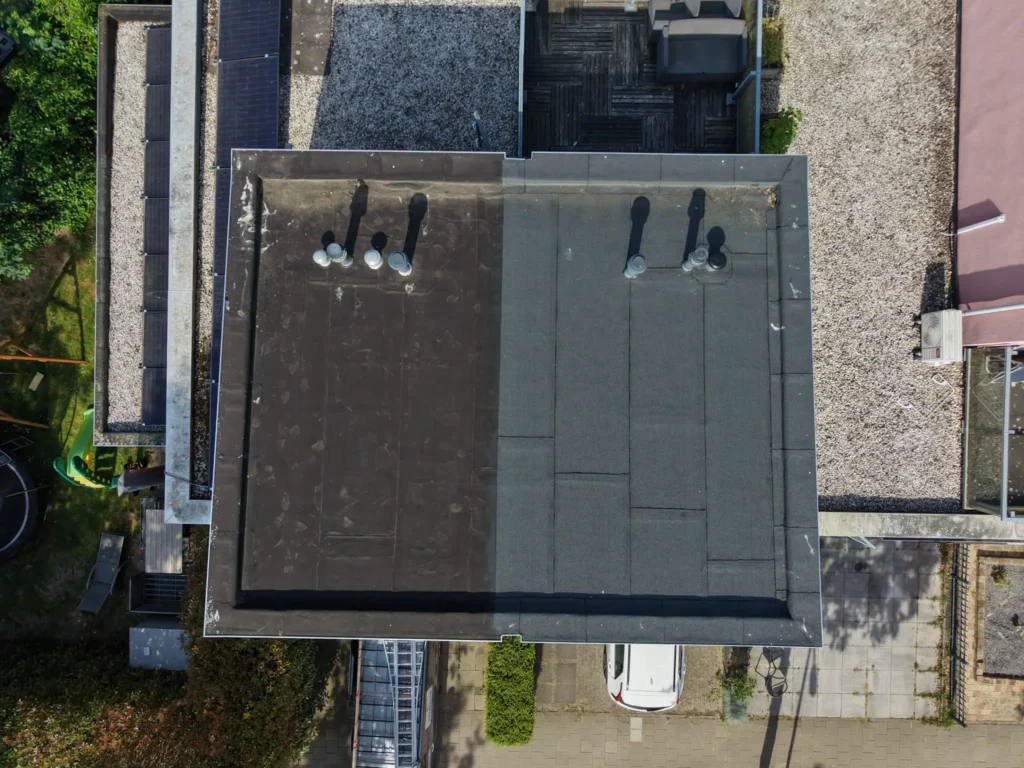
A flat roof is never really flat. There is always a slight slope towards the outlet, and that slope is one of the most important things about the whole roof. Yet it is the part that is talked about least, because you cannot see it.
What you can see is the result: puddles that remain after a shower. If they are still there after a day, something is wrong.
Why standing water is so damaging
Permanent load. Water is heavy. A puddle a few centimetres deep over a large area pushes the structure down further, which makes the puddle even deeper. That process reinforces itself.
Dirt and growth. Leaves and sludge collect in standing water, and algae and moss grow in it. That holds moisture and attacks the top layer.
Accelerated ageing. Bitumen that is permanently wet loses its top-layer protection faster. The slate chippings wash away and the bitumen is exposed.
Frost damage. Water that sits in a seam or small crack and freezes expands and makes the opening bigger. A little more every winter.
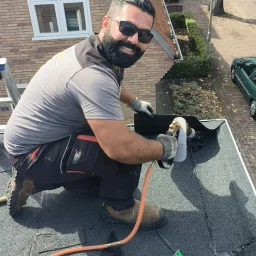
“I can repair a roof, but if the water keeps standing on it, I will be repairing the same spot five years later.”
Fouad, owner of Astrodak Service
How much fall is needed
As a guideline, a slight fall of around one and a half percent is often used, which comes to about one and a half centimetres of height difference per metre. More important than the exact figure is that the whole roof slope runs to an outlet and that there is no low point without an outlet anywhere.
In practice, roofs rarely drain exactly as they were drawn. A structure settles over decades, a joist sags, and then a low point forms in the middle of the area where the water stays.
Puddle after a day
too little fall
action needed
Have it checked before it becomes a job
Most of the damage I repair was still a small fix a year earlier. Have your roof checked with no obligation and you will know exactly where you stand.
What can be done about it
The outlet first. Surprisingly often, the problem is not the fall but an outlet that is blocked or sits too high. See
a blocked outlet.
An extra outlet. For a low point without an outlet, a second downpipe outlet or an emergency overflow is sometimes the simplest solution.
Tapered insulation. With a new build-up, the fall can be created in the insulation layer using boards of increasing thickness. This is the neat solution, and the moment to do it is when the roof is being renewed anyway.
Tackling the structure. With sagging joists, it is a structural problem. That is not roofing work in the usual sense and first requires an assessment of the load-bearing capacity.
Why this is the most important conversation for a replacement
If you have a flat roof renewed and the new covering goes on the same level base, the water will stay in the same place and the new roof will age just as fast as the old one. That is a shame, because a replacement is exactly when the fall can be improved for relatively little extra cost.
The emergency overflow that is often missing
On a flat roof with an upstand all round, the water has nowhere to go if the outlet is blocked and rises above the lowest seam. An emergency overflow, a short pipe through the upstand a few centimetres above the roof surface, lets that water run out before it reaches that level.
It is a small part that is missing on many existing roofs and that can prevent a leak that would otherwise come inside. With a replacement we include it as standard, and on an existing roof it can be fitted afterwards.
Frequently asked questions about fall