This question comes in two versions. Someone wants to go up on the roof themselves to empty the gutter or adjust a satellite dish, or someone wonders whether the roof of the extension could be used as a terrace. Those are two very different conversations.
The structure will almost always carry a person. It is the covering you need to be careful with.
What walking does to a roof covering
In warm weather, bitumen is soft. On a hot day a heel can leave a dent in the top layer and push away the mineral slate chippings. That is exactly where UV damage starts later on. So walk on it in the morning or on a cool day.
In frost, it is brittle. Cold bitumen has hardly any stretch. A step on a seam or a fold can then cause a small crack that you cannot see.
Seams and penetrations are vulnerable. The flat areas are the best places to step. Keep away from seams, upstand folds and the edges around penetrations and rooflights.
Gravel makes it worse. Under your foot, a sharp piece of gravel acts like a chisel on the covering. On a gravel roof, feeling your way step by step matters more than walking across quickly.
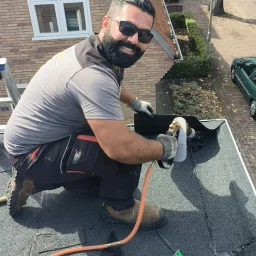
“A flat roof carries you perfectly well. It is the sole of your shoe that harms the roof, not your weight.”
Fouad, owner of Astrodak Service
Safety comes first
More important than the covering is that you do not fall. A flat roof without an edge or railing is a flat surface with a drop all around it, and in wet weather or with moss it is slippery. Do not go up on the roof alone, and not from a ladder that is not secure.
And if you have any doubt about the structure, do not go up at all. A roof that feels spongy has water in the build-up and possibly damaged timber underneath. See
wet insulation.
Dry and cool
careful
usually no problem
Hot or freezing
better not
covering vulnerable
Have it checked before it becomes a job
Most of the damage I repair was still a small fix a year earlier. Have your roof checked with no obligation and you will know exactly where you stand.
If people need to walk on it regularly
A roof with equipment on it, a satellite dish or a spot you need to reach more often should have a walkway: rubber walkway mats, tiles on pedestals or a strip of extra covering. It costs little and prevents a worn path forming where the covering ages faster than the rest.
On older roofs I often see that path as a strip of bare patches from the drain to the rooflight. That is where the roof will leak first, and it could have been prevented with a mat.
A flat roof as a terrace
That is something different from walking on it now and then. A roof terrace needs a covering that is suitable for it, a supporting structure that can take the load of people and furniture, tiles on pedestals so the water can drain away underneath, and a safe edge or balustrade.
On top of that, you often need an environmental permit, partly because of privacy and the view into the neighbours' property. That is not something to sort out afterwards. See
permits for roofing work and the
page about flat roofs.
Solar panels on a flat roof
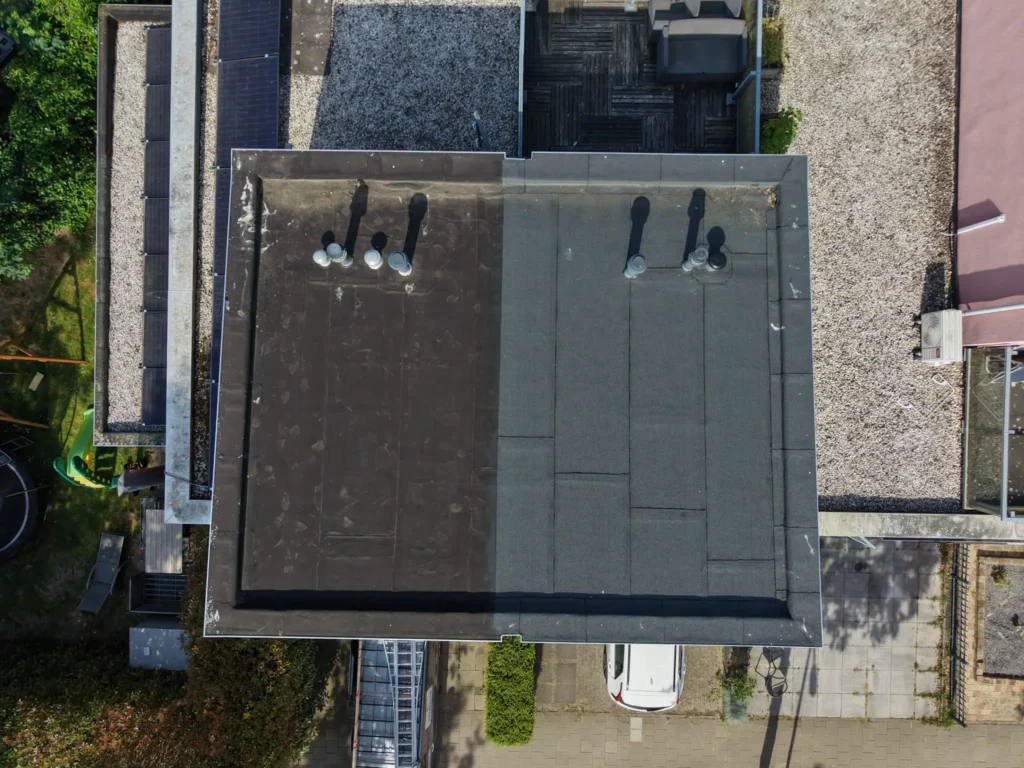
With panels on a flat roof, people walk on it during installation and at every service visit, and they do so in the spaces between the rows. So that is where a walkway should be, and in practice it is often forgotten because the installer is not the same company as the roofer.
Even more important: do not have panels installed on a roof that needs replacing within ten years. They will then have to come off and go back on, and those costs come on top of the roof replacement. So have the roof assessed first. See
the lifespan of a flat roof.
Frequently asked questions about walking on a flat roof