Green roofs are popular, and for good reasons. They retain rainwater, keep the space below cooler in summer, extend the life of the covering and look considerably nicer from above than gravel.
But it is not something you just lay on top. There are three conditions, and if one of them is not met, it is not a good plan.
The three conditions
Load-bearing capacity. A saturated sedum roof weighs considerably more than a dry one, because the substrate layer full of water is heavy. The structure has to be able to carry that, even after three days of rain.
A root-resistant covering. Not every roof covering can withstand roots growing through. EPDM and bitumen specially made for it with a root-resistant additive can, ordinary bitumen not always. Otherwise a separate root barrier membrane is added.
Good drainage. The water the substrate does not hold has to be able to drain away. That needs a drainage layer and outlets that stay accessible, even with plants over them.
“A green roof is not a garden on a roof. It is a roof covering with a layer on top that needs to be properly thought through.”
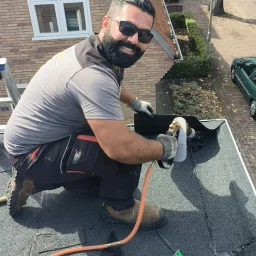
Fouad, owner of Astrodak Service
What it gives you
The most concrete benefit is protection of the covering. Under a green roof there is no UV and the temperature swings are much smaller, so the covering ages more slowly. That is a real extension of your roof's life.
In addition, the substrate holds part of a rain shower and releases it later, which reduces the load on the sewer. Some municipalities give a contribution for this, so it is worth asking. And in summer the space below stays noticeably cooler.
Not sure about the right approach?
I would rather come and look at your roof with my colleagues first than come up with a solution from a distance. During the free inspection you hear what is really needed, even if that is less than you thought.
Extensive or intensive
Extensive is the light version: a thin substrate layer with sedum and succulents. Little weight, little maintenance, and this is what most people mean when they talk about a green roof. Check it twice a year and feed it now and then.
Intensive is a real roof garden with grass, herbs or even shrubs. Considerably heavier, more build-up and real maintenance with watering. That almost always needs a structure designed for it, and that is rarely the case with an existing extension.
Where it goes wrong in practice
Outlets that can no longer be reached. An outlet that disappears under the plants no longer gets checked and becomes blocked. Every outlet needs an inspection chamber or gravel surround.
A missing edge zone. Around the roof there should be a gravel strip or paved edge, so the covering at the upstand stays clear and can be inspected.
On a roof that had had its day. A green roof on a twenty-five-year-old covering is money thrown away. The logical moment is straight after a replacement.
No maintenance. Even an extensive roof needs attention twice a year. Without it, weeds overgrow the sedum and the outlets get blocked.
What we advise
If you are considering a green roof, do it together with replacing the covering. Then we choose a root-resistant build-up straight away, get the fall right and keep the outlets accessible. Laying a green roof on an existing covering afterwards is often possible but rarely the smart route.
And have the load-bearing capacity checked first. That is not a roofer's judgement but a structural question, and it is the only condition for which there is no workaround at all. See the
page about flat roofs and
free roof inspection.
What a green roof does with rainwater
An extensive sedum roof holds part of a rain shower in the substrate and releases it slowly later. In a short, heavy downpour, that means a noticeably lower peak load on the outlet and on the sewer, and that is exactly why municipalities sometimes give a contribution for it.
For you personally, the practical benefit is that the outlet works at its maximum less often. The substrate does stay saturated after a long rainy period, though, and then the weight is at its highest. That is the scenario the structure should be assessed for.
Frequently asked questions about green roofs