This is one of the most confusing leaks there is. On an ordinary rainy day there is nothing. During an autumn storm with rain from the south-west there is water on the floor. And when the roofer comes to look a week later, everything is dry and nobody sees a thing.
Yet this is often one of the easier leaks to explain, once you understand what wind does to water.
Why wind makes the difference
A roof is made to let water run downwards. Tiles overlap each other, membrane runs to the gutter, joints have an overlap that works from top to bottom. That works as long as water is falling.
In strong wind, water no longer falls, it is pushed. Horizontally, and up the roof slope. Then water gets behind the raised edge of a tile, under a lead flashing that is just too short, past a bargeboard that does not fit properly. All places where water never gets in normal rain.
The lead work at the chimney. Flashings with too little overlap or a wrongly turned edge let water through in sideways rain. See
replacing lead flashing.
The bargeboard and the roof edge. The side of the roof is where the wind grips hardest. A loose or missing bargeboard is a classic. See
replacing a bargeboard.
The ridge. Ridge tiles set in crumbling mortar let water and snow under the ridge when the wind blows upwards. See
damp patches along the ridge.
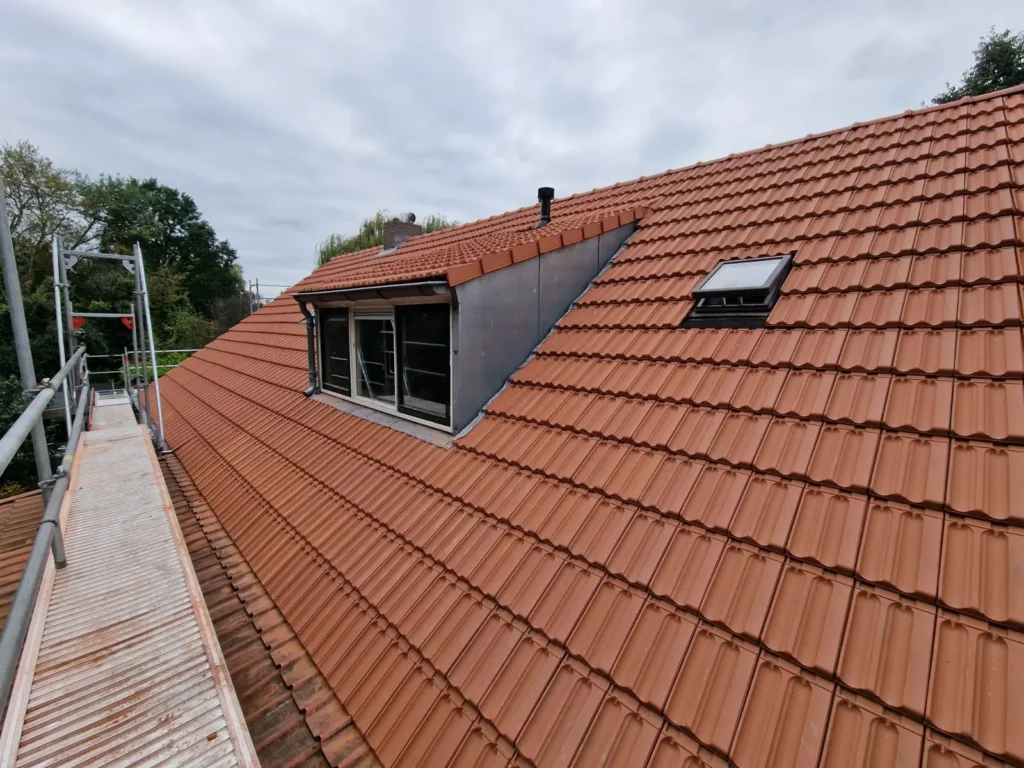
Roof window and dormer. The top and sides of a window are exactly where pushed water collects. See
leaks at a dormer.
“In a storm, water does not fall down, it is pushed up. An old roof is rarely built for that.”
Fouad, owner of Astrodak Service
The wind direction is your most important clue
If you remember one thing from this article: write down which direction the wind was coming from when it leaked. That halves the search area straight away. If it leaks in wind from the south-west, we do not need to check the north-east side of the roof.
In our region most driving rain comes from the south-west, so that is also the side that takes the most punishment and where joints are the first to fall short. If you make a note of the date, wind direction and where the water came in two or three times, you have a record a roofer can really work with.
A leak? Do not let it spread.
A leak you leave for a season usually costs ten times as much in follow-on damage. Call or send a message: you will get an answer today, from me personally, not from a scheduler.
Why this leak often goes unfound
Because in dry weather it does not exist. A roofer who comes to look on a windless day sees a roof in good condition and leaves again. A water test with a garden hose from below does not work either, because it imitates falling rain, not pushed rain.
What does work: following the trail in the attic back to the side of the roof the wind comes from, and then checking the joints on that side by hand. Measuring overlaps, lifting lead, checking whether the membrane runs all the way into the gutter. That is slow work and it is the only way.
What the solution usually is
Almost always improving the detail rather than replacing the roof surface. New lead with a wider overlap, refitting the bargeboard, dry-fixing a ridge tile, or renewing a flashing piece at a roof window. That is a targeted repair, not a renovation.
What changes in winter
This type of leak almost always comes to light in autumn and winter, and that is no coincidence. In those months the wind comes from the south-west more often and more strongly, the rain lasts longer and nothing dries out between two showers. A joint that had just enough overlap in summer then falls short.
That is why people often say the leak was not there last year. Usually it was, but the weather had not found it. That is also why I would rather check a roof in autumn than in June.
Frequently asked questions about leaks in driving rain