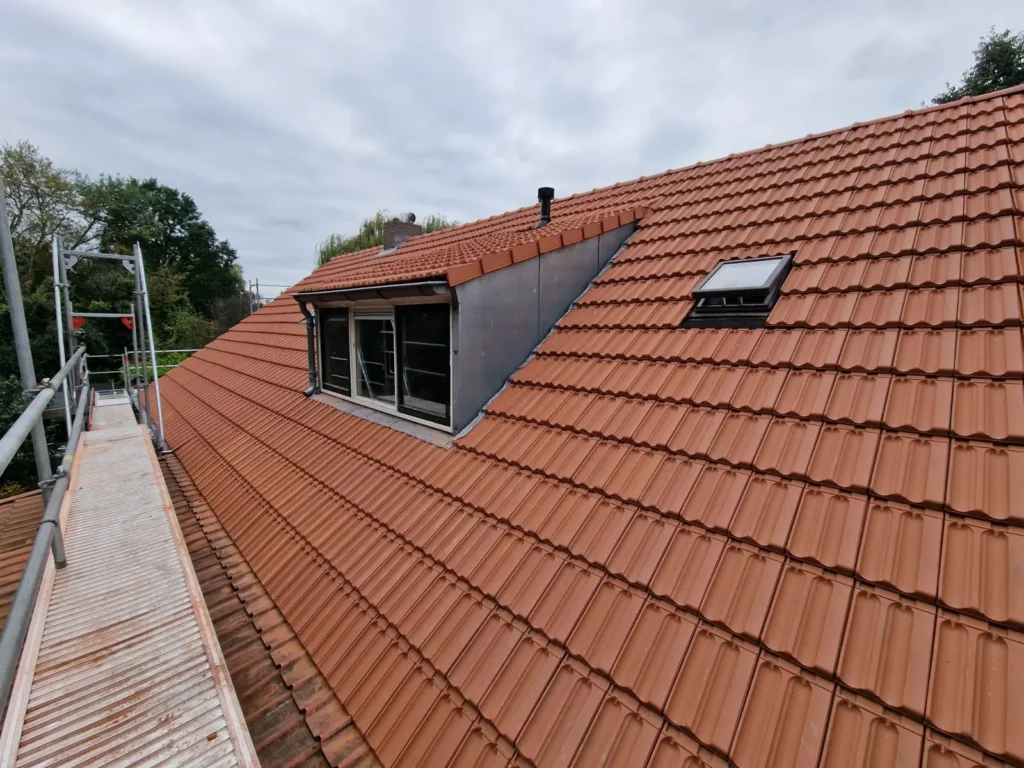
When someone calls me about a leak and there is a dormer in the roof, that is the first place I look. Not because a dormer is bad, but because more joints come together in that small piece of roof than in the whole rest of the roof.
Count them: a small flat roof on top, two cheeks, a top joint against the sloping roof, a bottom joint onto the tiles, gutter pieces on either side, and then the window frames themselves. Each of those transitions is a detail that was made at some point and will age at some point.
The five places where it goes wrong
The top joint. Where the small flat roof of the dormer meets the sloping roof. All the water from the roof above the dormer flows past here. With too little upstand or old lead work, it gets behind the covering.
The cheeks. The vertical sides. Water coming off the roof above the dormer runs down along the cheeks. If the joint with the tiles is not right there, the water goes into the roof instead of over it.
The bottom joint. Where the frame or the bottom of the dormer meets the tiles. Often with a lead flashing or a gutter piece that starts to move over the years.
The small flat roof. A small area, a lot of edge, and usually little fall. Exactly the combination where water stays standing. See
fall on a flat roof.
The window frames and glazing. Weathered sealant joints and old timber let water through even when there is nothing wrong with the roofing. This looks like a roof leak but is not one.
“A dormer is not a roof with a window in it. It is seven joints on two square metres.”
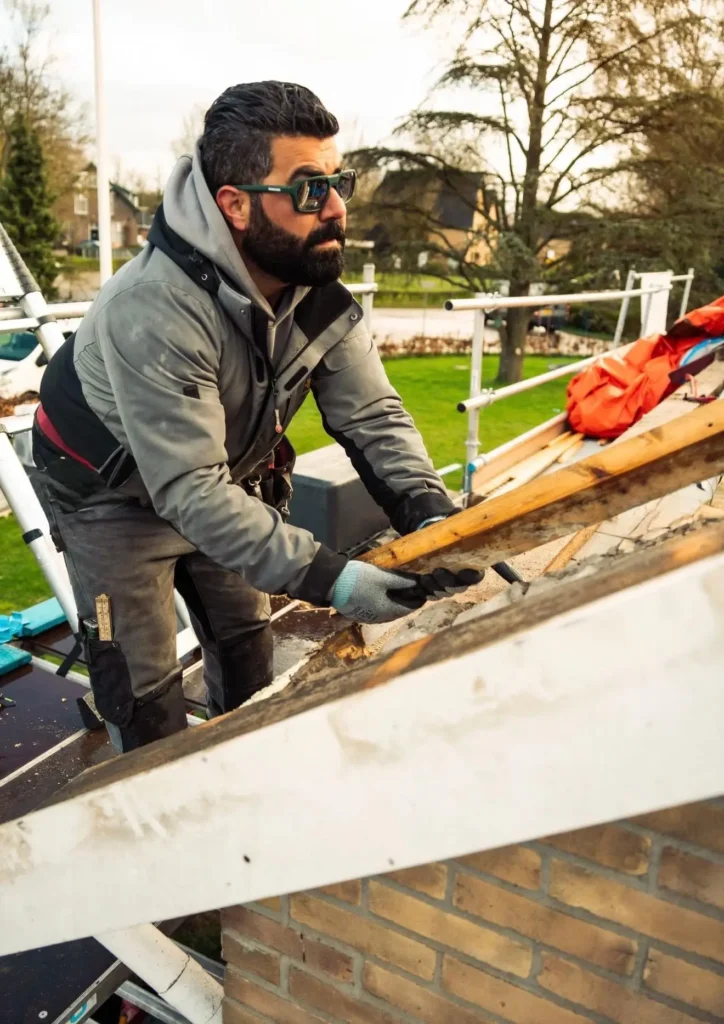
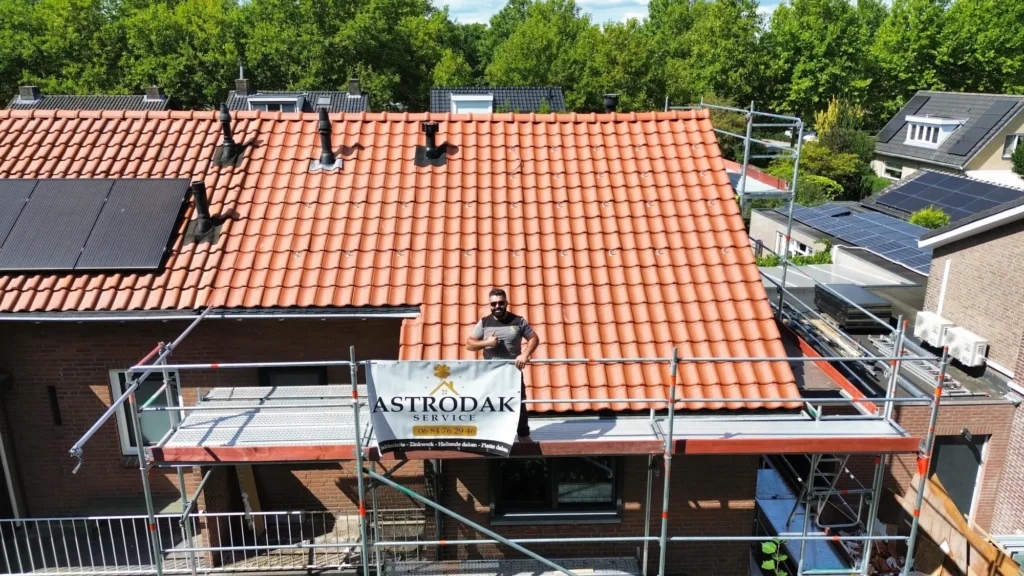
Fouad, owner of Astrodak Service
How to tell which of the five it is
Look at where the water comes into the dormer itself. If it comes down along the top, it is the top joint or the small flat roof. If it comes in at the side, along the cheek, it is the side joint. If it appears under the frame, look at the sealant joints and the timber first before you suspect the roofing.
And pay attention to the weather. If it only leaks in strong wind from one direction, water is being pushed up against a cheek and the overlap there is too small. See
leaks in driving rain.
Water along the top
top joint
or small flat roof
A leak? Do not let it spread.
A leak you leave for a season usually costs ten times as much in follow-on damage. Call or send a message: you will get an answer today, from me personally, not from a scheduler.
Why old dormers leak more often
Dormers built twenty to forty years ago were often finished with lead and zinc in a way that was normal at the time. Lead moves with temperature, and flashings that are fixed on both sides or made too long crack at the bend. That is not bad workmanship from back then, it is how the material behaves over decades.
With later prefab dormers I more often see problems with the small flat roof and the roof edge profiles, because they have to absorb a lot of expansion over a small area. In both cases the solution is to remake the detail, not to replace the whole dormer.
What the repair usually involves
Removing the tiles around the dormer, taking out the old lead, fitting new lead work with a wider overlap worked in the right way, and putting the tiles back. On the small flat roof, sometimes a new covering with a better fall. It is precision work where the overlaps and fixings are what count, and it is a one-day job.
The joint with the neighbours
On a terraced house a dormer is often close to the property boundary, and sometimes it adjoins the neighbours’ dormer. Then the joint between the two cheeks is a detail that belongs to two houses and that nobody feels responsible for.
If it leaks there, the practical thing is to have it tackled together with the neighbours, because half a repair on one side rarely works. That can be an awkward conversation, and it is almost always cheaper than doing half the job twice.
Frequently asked questions about dormer leaks