With an extension that has a flat roof, this question almost always comes up. You want daylight in a room that otherwise only has windows on one side, and then there are two ways to go.
Both work. The difference lies in how much light you get, what it asks of your roof and how much edge has to stay watertight.
The rooflight
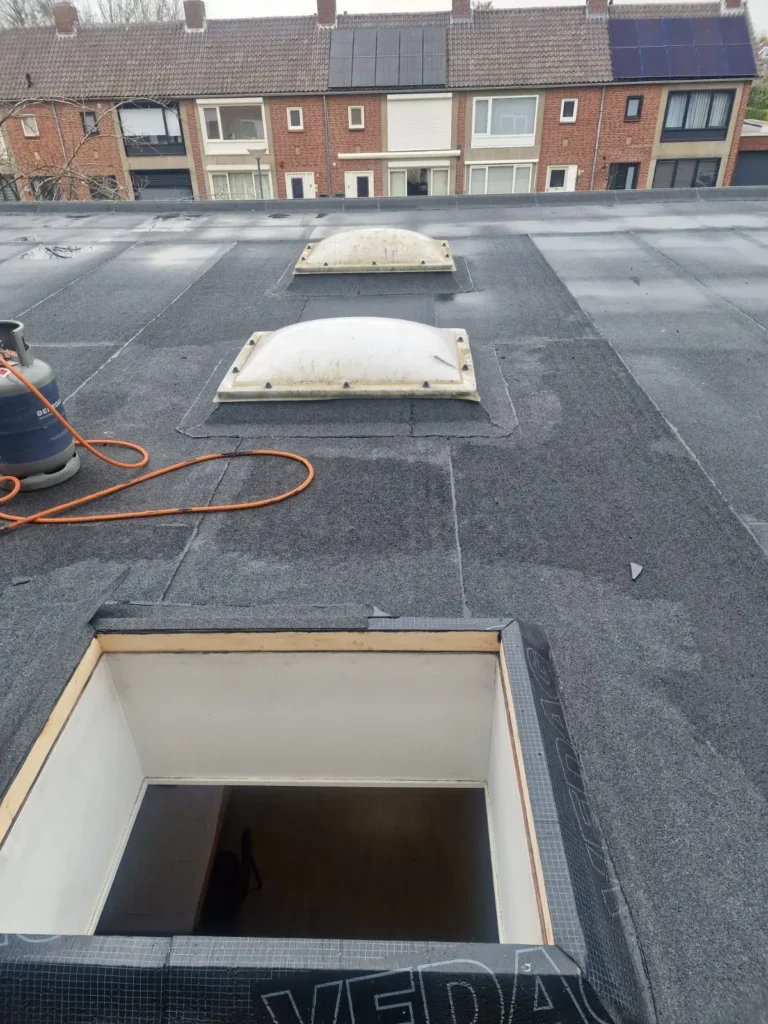
Compact and simple. A rooflight sits on a plastic or timber upstand, with the covering turned up around it. A proven detail that is easy to finish well.
Little edge. Fewer joints means fewer places where it can ever go wrong. On a flat roof that is a real argument.
Can be opened or ventilated. There are rooflights with a riser or an electric opener, useful if there is no other ventilation in that room.
Limited light. You get light in a beam in one place, not evenly across the room. Two small rooflights often give a nicer result than one large one.
The roof lantern
Much more daylight. A long or large roof lantern lights a whole room instead of one spot. The difference in how the room feels is considerable.
A flatter look. A roof lantern bulges less above the roof and looks sleeker from inside and outside.
More demands on the structure. The opening in the roof is larger, so trimming or an extra joist is more often needed. That is structural work.
More edge and more heat. More joints to keep watertight, and more glass means more heat build-up. Sun shading or special glazing is needed sooner with a roof lantern than with a rooflight.
“Two small rooflights often give a nicer light than one large one. Light coming from two directions does not cast harsh shadows.”
Fouad, owner of Astrodak Service
Roof lantern
lots of light
more structural work
Not sure about the right approach?
I would rather come and look at your roof with my colleagues first than come up with a solution from a distance. During the free inspection you hear what is really needed, even if that is less than you thought.
What to look out for with both
The upstand. That is the raised edge the rooflight or roof lantern sits on and up which the covering is turned. If it is too low, the water level can rise above the edge when water stands on the roof. A generous upstand is the most important condition for a detail that lasts for decades.
And the position on the roof. A rooflight at a low point where water stays standing is asking for trouble, however well it is finished. See
fall on a flat roof.
Heat is the most underestimated factor
Glass or plastic in a flat roof looks straight up at the sky and so catches much more sun than a window in a wall. In an extension with a large roof lantern it can get really uncomfortably hot in July.
That can be dealt with using solar control glazing, a multi-layer rooflight or external shading, but that is a choice you want to make in advance, not after the first summer. See also
keeping a roof window cool.
When replacement makes sense
Thirty-year-old rooflights are often yellowed and dull, and the plastic develops hairline cracks. Then less light gets through than intended and the rooflight itself is a leak risk. When the roof is replaced, that is the logical moment to include them, because the covering around them comes off anyway.
Including ventilation in your choice
With an extension that has a flat roof, there is often no other way to ventilate than a window in the wall. A rooflight or roof lantern that opens solves that, and that is a reason to choose that version even if you rarely open it.
With a kitchen or bathroom under a flat roof, that counts for even more, because a lot of moisture is released there. An opening rooflight with an electric opener is then not a luxury but a solution to a problem you would otherwise be fighting with a dehumidifier.
Frequently asked questions about daylight in a flat roof