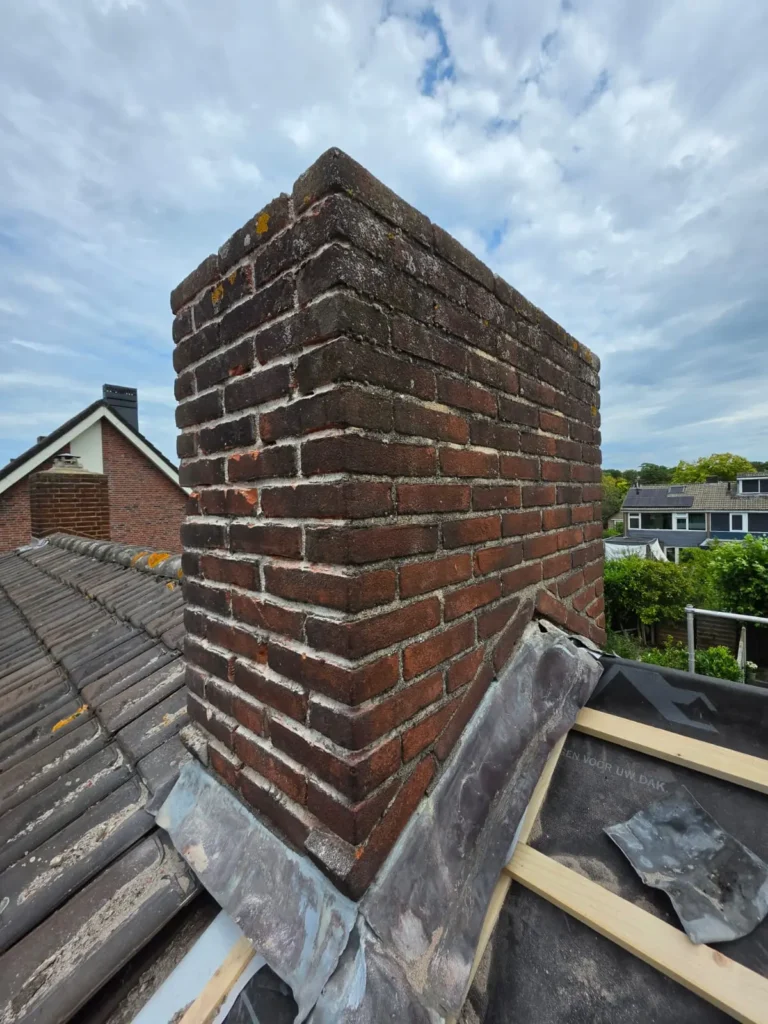
Where two roof slopes meet in an internal corner, there is a valley gutter: a strip of zinc, lead or a plastic profile that collects the water from both slopes and carries it to the gutter. A roof with a dormer, an extension or an L shape always has at least one.
And it is the place where I find the most damaged roof boarding. Not because valley gutters are badly made, but because the load there is simply the highest.
Why the load is so high there
All the water comes together. Two roof slopes, each tens of square metres in size, drain onto one strip thirty to forty centimetres wide. In a heavy shower that is a considerable amount of fast-moving water.
Leaves and silt stay put. The valley is a dip, and everything that comes over the roof ends up there. A clump of leaves holds the water back and then it rises above the edge of the profile.
The profile is sometimes too narrow. With a large roof area or a shallow pitch, a standard valley gutter width is not always enough. Then the gutter overflows its edge in a heavy downpour.
There is timber under the profile. Water that comes over the edge goes straight into the boarding. You cannot see it there and it rots from the inside. See
replacing roof boarding.
“The valley gutter is your roof’s drain. And just like a drain, you only notice something when it has not been working for a while.”
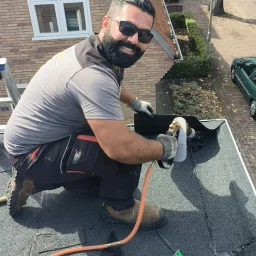
Fouad, owner of Astrodak Service
Warning signs
Inside: a damp patch or lime streak on the boarding that runs upwards towards the valley. Outside: leaves piling up in the valley, or tiles along the valley that have sunk or lie crooked because the timber underneath has given way.
And pay attention to when it happens. A valley gutter leak often only occurs in heavy showers, because that is when the water comes over the edge. In light rain nothing happens, and that makes it hard to trace. See
tracing a leak.
In heavy showers
a leak
water over the edge
A leak? Do not let it spread.
A leak you leave for a season usually costs ten times as much in follow-on damage. Call or send a message: you will get an answer today, from me personally, not from a scheduler.
What a repair involves
The tiles on both sides of the valley come off, the old profile comes out, the boarding is assessed and replaced where needed, and a new valley gutter profile goes in, wide enough and with the right upstand on both sides. Then the tiles go back, neatly cut to size along the valley.
That last part is precision work: the tiles along a valley have to be cut at an angle and still fit tightly. Done carelessly, a gap remains where leaves get caught, and then the same story starts all over again.
What you can do to prevent it
Keep the valley clear. On a roof with trees nearby, that means a quick check once or twice a year, and that is the only maintenance task that really makes a difference here. If the valley is hard to reach, it belongs in a maintenance round.
Why the tiles along the valley give the work away
Along a valley gutter the tiles are cut at an angle, and that is the part where you can see how carefully the work was done. Done neatly, the tiles meet with an even edge along the valley. Done carelessly, the edge is irregular and gaps are left.
Those gaps catch leaves, leaves hold back water, and water that is held back comes over the edge of the profile. That is how a finishing issue becomes a leak after a few years. So look at it when the work is handed over, because later it can no longer be corrected.
Frequently asked questions about valley gutters