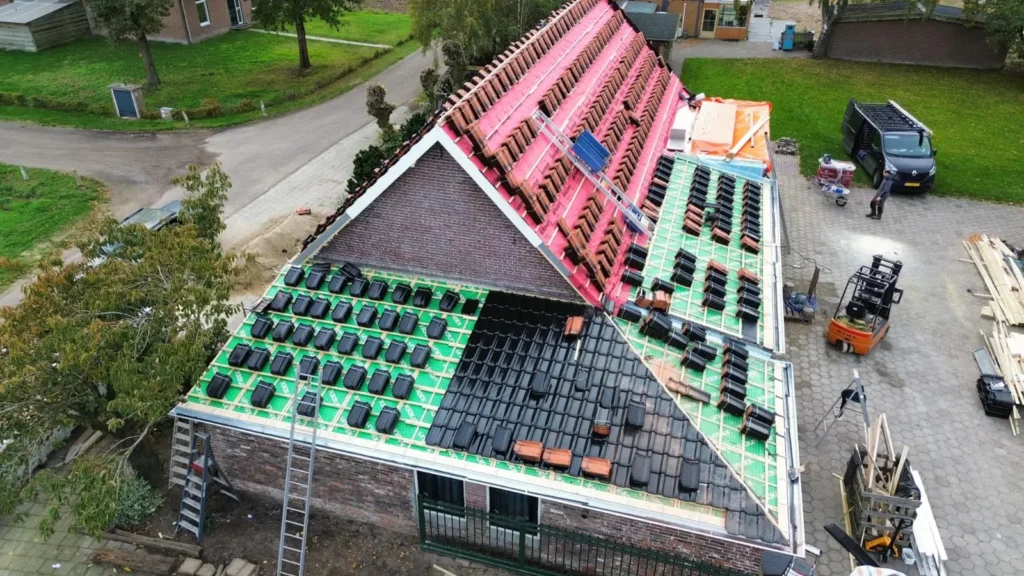
Of all the parts of a tiled roof, this is the least known and one of the most important. When someone asks why a forty-year-old roof needs replacing while the tiles are still fine, the answer is about this.
The build-up from outside to inside is: tiles, tiling battens, counter battens, membrane, roof boarding. Together, that second and third layer do something you cannot see, but which does determine whether your roof stays dry.
What counter battens do
A tiled roof is not a watertight layer. It is a rain shield, and in driving rain or snow some water always gets behind the tiles. That water lands on the membrane and has to be able to run to the gutter.
The counter battens, the vertical strips on the membrane, provide the space for that. Without counter battens, the tiling battens lie directly on the membrane and hold back the water, so it stands against the batten. Then the batten rots and the membrane is put under strain. A roof without counter battens is a roof that is always wet in one place.
They create the water channel. Water that has got behind the tiles can run along the counter battens to the gutter instead of standing against a batten.
They provide ventilation. The space between membrane and tiles lets air through, so moisture can dry. On an insulated roof that is even more important. See
insulation and ventilation.
They keep the tiling batten dry. So the tiling batten lasts longer, and with it the whole roof.
They are invisible after completion. Which is also why they are sometimes skipped.
“If someone lays a roof without counter battens, you never see it after completion. You notice it fifteen years later.”
Fouad, owner of Astrodak Service
Why the batten spacing has to be exact
Every tile has its own size and therefore its own batten spacing. That spacing determines how much the tiles overlap, and so how much water can get between them in driving rain. Set out too wide and the roof leaks in wind; too tight and the tiles do not close.
On a new roof that spacing is calculated and set out across the roof slope, divided so that the top and bottom rows come out right. That is why setting out a roof is one of the most decisive steps of the whole job, and why working fast gains nothing here.
Tiling battens and counter battens
Ceramic tile
50 years or more
lifespan
Not sure about the right approach?
I would rather come and look at your roof with my colleagues first than come up with a solution from a distance. During the free inspection you hear what is really needed, even if that is less than you thought.
How to assess their condition
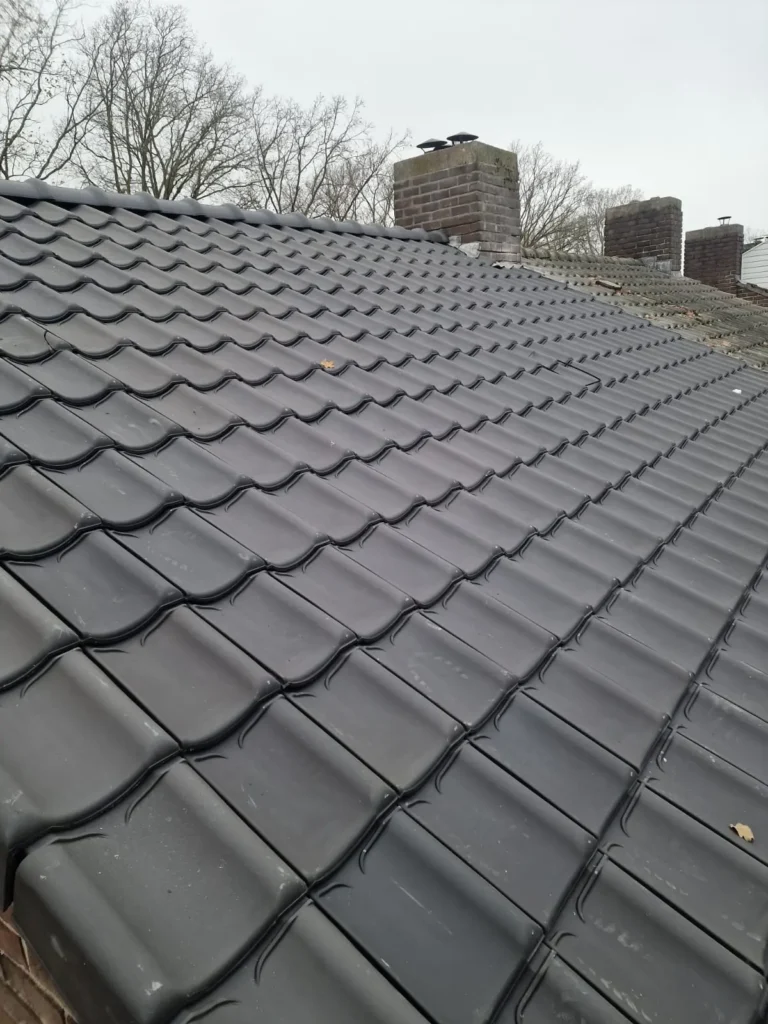
You cannot see it from the ground or from inside, because it is between the membrane and the tiles. There are two indirect clues, though. The first: are the tiles still level and in straight rows? Wavy rows or tiles that sag slightly mean the battens are giving way.
The second: how old is the roof? At thirty to fifty years, battens and membrane are usually at the end of their life, even if there has never been a leak. That is not wear from use, but from time and moisture.
What it means for a renovation
That the battens and counter battens are replaced, even if the tiles stay on. That is exactly what relaying is: tiles off, membrane, counter battens and tiling battens renewed, tiles back on. You then get a roof with a fresh substructure and keep your tiles.
Why setting out is the most important day
Setting out a roof means determining the batten spacing over the whole roof slope, so that the bottom and top rows come out right and the overlaps are the same everywhere. That is calculation and measuring work, and it happens at the start of the job.
A roof that has been set out wrongly lies crooked or with overlaps that are too wide, and that cannot be corrected later without redoing everything. That is why a roofer who takes his time on this day is doing so for the right reason.
Frequently asked questions about tiling battens and counter battens