Wind does not attack a roof in the middle. It attacks at the edges, and that is exactly where almost nobody looks. After a storm, the first glance goes to the spot where a tile used to be, while the damage that will cost money is usually a few metres higher.
From the ground, in this order
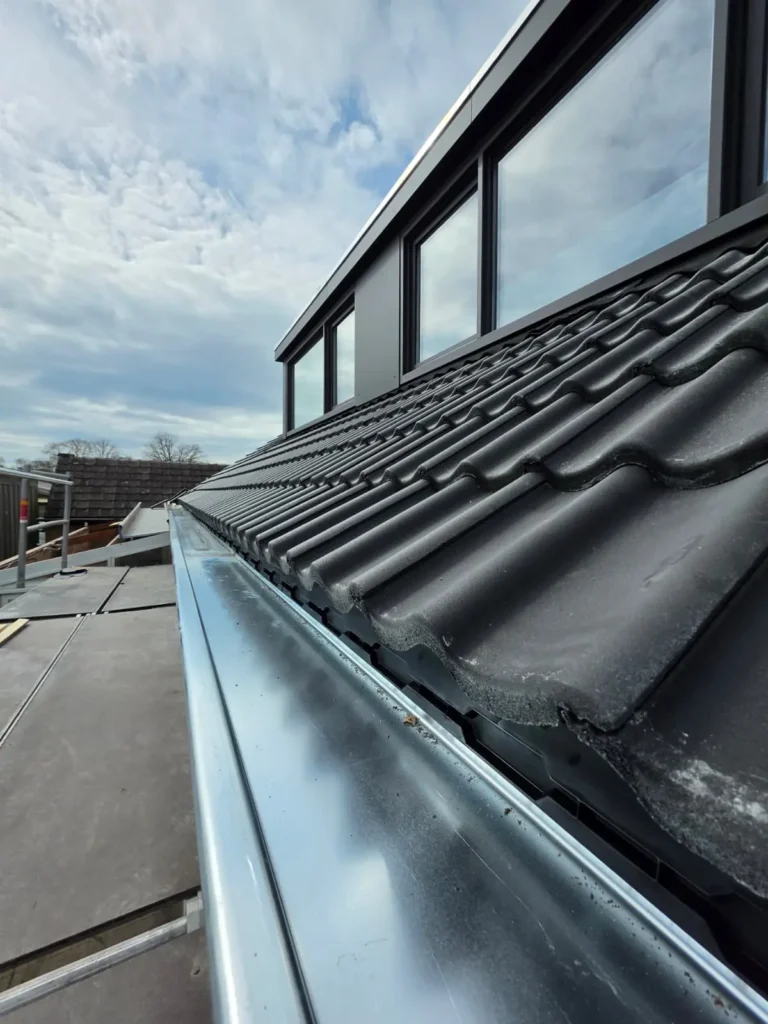
The ridge. Are the ridge tiles still in one line? Shifted ridge tiles are the most common problem after a storm, and the least reported. See
loose ridge tiles.
The sides of the roof slope. The bargeboard is where the wind attacks hardest. If it has come loose or split, that is an urgent problem, because the wind can get under the tiles there. See
replacing a bargeboard.
The rows of tiles. Look for irregularities in the pattern. A tile that sits slightly higher is a tile that has come off its batten.
The gutter and the garden. Pieces of tile, lumps of mortar, slate chippings or a piece of lead. That tells you where something has broken, even if you cannot see the spot.
The roof edge and the fascia board. With a flat roof: is the roof edge trim still secure and has the covering not been lifted? See
roof edge finishing.
“Almost nobody calls about the ridge after a storm. And that is almost always where the damage is.”
Fouad, owner of Astrodak Service
From inside, in the attic
Do this even if you saw nothing outside. Take a lamp and look up: is daylight coming through anywhere it should not? Then feel the roof boarding at the ridge, by the chimney and at the eaves to see whether it is damp.
A tile that was lifted during the storm and fell back into place looks completely normal from the ground, while a bucket of water has blown in. You will only find that spot from inside. See
following the water trail.
First
ridge and edges
from the ground
A leak? Do not let it spread.
A leak you leave for a season usually costs ten times as much in follow-on damage. Call or send a message: you will get an answer today, from me personally, not from a scheduler.
What not to do
Go up on the roof. Not during the storm, and not the morning after if it is still windy or wet. Everything you need to know about a roof, you can see from the ground and from inside. Every year people fall off their own roof while trying to fix something a bucket could have caught.
And do not remove tiles to see what is underneath. Then you open the roof at the very moment it needs to be closed, and the next shower is often not far away.
Reporting and recording
Report it quickly to your insurer. Even if you do not yet know exactly what it is. The date you reported it will matter more later than you think now.
Take dated photos. Of the damage, of the debris and of the spot on the roof. Take new photos if it gets worse.
Record the weather. The date and wind force of the storm. A screenshot of that day's weather forecast is perfectly good supporting evidence.
Ask for a report. We put in writing what we found and what the cause was, with photos. That is the document a loss adjuster asks for. See
insurance for a roof leak.
Why acting quickly counts extra here
A roof holds itself in place: the tiles overlap and the rows at the edge hold the rest. As soon as one edge comes loose, the wind can get underneath, and with the next storm it goes further. What is one tile now could be a whole roof slope by November.
What you can see from the neighbours
In a row of identical houses, the neighbours' roof is a free reference. If their ridge tiles are neatly in line and yours are not, you know it is not just down to the weather. If there is something in your gutter and not in theirs, that tells you something too.
And the other way round: if there is damage all along the street, it was an exceptional storm and your insurer will see it that way too. In that case a photo of the street is useful supporting evidence for your claim.
Frequently asked questions about checking after a storm