Rustling above the ceiling is one of those things that seems minor during the day and grows at night. Usually it is birds, and then it is a manageable problem. Sometimes it is a marten, and then it is a different story.
Telling them apart is the first step, because the approach is different and so are the rules.
Birds or a marten
Birds: noise in spring and in daylight. Pattering, cheeping of chicks, activity around the eaves in the morning. They usually stay in the space under the tiles and do not get into the insulation.
A marten: noise in the evening and at night. Heavier thumping, dragging sounds and sometimes a penetrating smell. A marten gets further into the structure, drags in nesting material and damages insulation.
Traces at the eaves. Nesting material, feathers or droppings on the gutter or under the roof edge. With a marten, often a greasy smear along a downpipe or wall.
Damage in the attic. Pulled-out insulation, gnawed membrane or cables: that points to a marten, not to birds.
“With birds, the nesting material is the problem. With a marten, the insulation is the problem.”
Fouad, owner of Astrodak Service
The rules to bear in mind
Breeding birds are protected. You may not remove or seal in a nest with eggs or chicks, which means closing up during the breeding season is not an option. You would shut the parents out and the chicks in, leaving a dead animal in your roof.
The stone marten is also a protected species. Driving it away and fitting deterrents is allowed, but catching or killing it is not. With bats in the attic the protection is even stricter, and a specialist is needed before anything is closed up.
Marten
evening and night
in the structure
Not sure about the right approach?
I would rather come and look at your roof with my colleagues first than come up with a solution from a distance. During the free inspection you hear what is really needed, even if that is less than you thought.
The right order
Find out what is there. From the noise, the time of day and the traces. If in doubt, wait and observe instead of closing up.
Wait until nothing is inside any more. With birds, after the breeding season. With a marten, after driving it away, and that takes patience.
Remove nesting material. Under the tiles and in the gutter. That material holds moisture against the membrane and the roof boarding, and that is the damage that stays.
Close the openings, breathably. Bird guards under the bottom row of tiles and at the ridge, fitted so that the ventilation is maintained. See
bird guards on the roof.
Repair the damage. Damaged insulation, gnawed-through membrane or wet roof boarding. See
wet insulation.
Where they get in
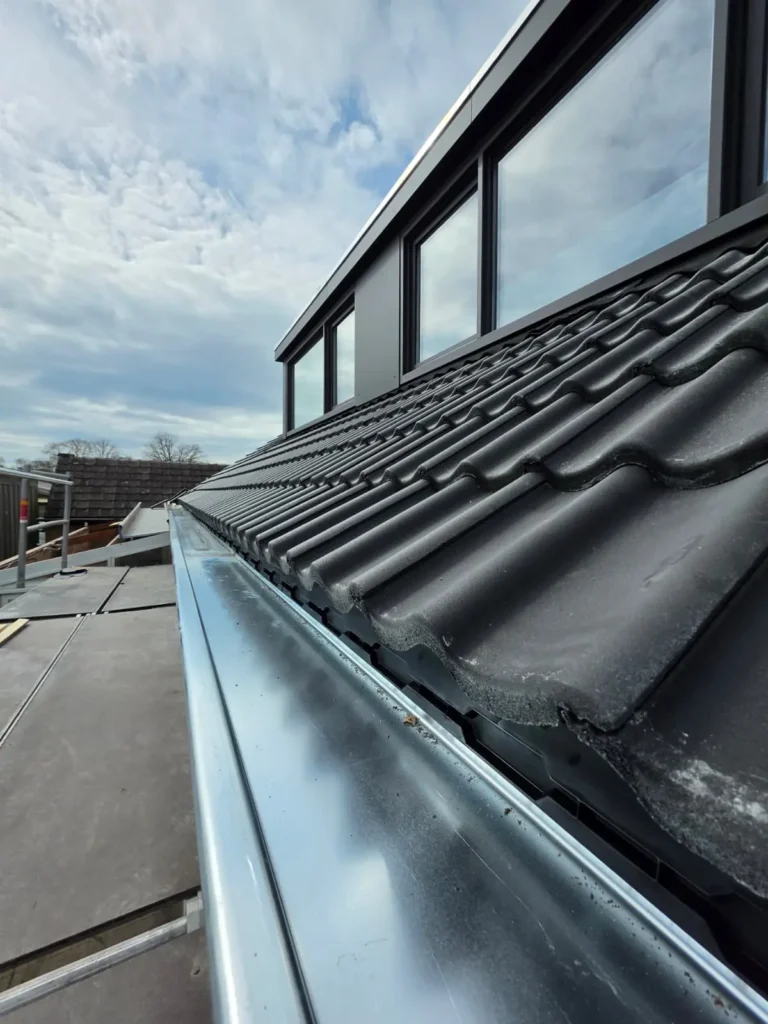
Almost always at the eaves, under the bottom row of tiles, where the ventilation opening is. Other places: at the ridge if the ridge tiles do not close properly, at a dormer where the junction is not sealed, and at a missing or broken tile.
A marten is also an excellent climber and uses a downpipe, a climbing plant or a tree next to the house as a step up. With a recurring problem, removing that step up is sometimes more effective than closing every opening.
What we do
We find out where the entrance is, remove nesting material and fit breathable guards at the eaves and the ridge. With a marten or bats, we tell you honestly that a specialist needs to be involved first, because closing up with an animal inside solves nothing.
What animal damage does to your insulation
With a marten, the damage is rarely just nesting material. Insulation is pulled out and compressed to make a nest, and compressed insulation no longer insulates. On an insulated roof that can cover a considerable area without you seeing it.
On top of that, the vapour control layer gets damaged, which means warm, moist air gets into the structure, leading to condensation. That is why a marten in the roof is not just a noise problem but also a building physics problem. See
the vapour control layer.
Frequently asked questions about animals in the roof