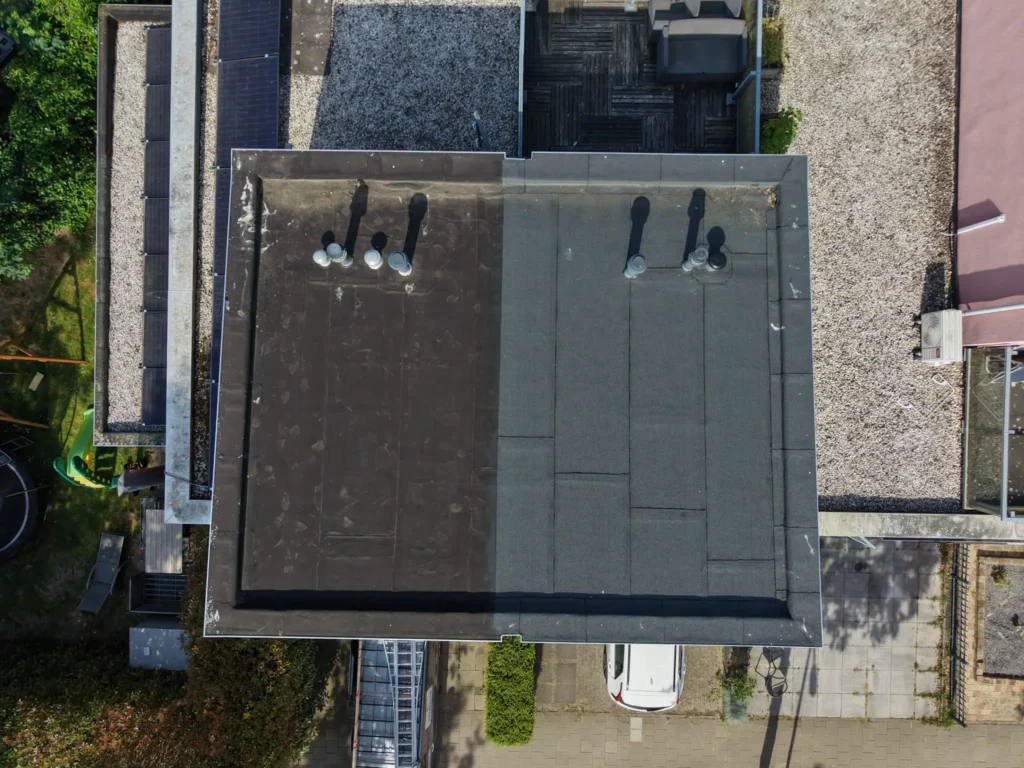
Every pipe, cable and vent that goes through your roof is in effect a hole. The roof is not watertight there because of the material but because of the finish around it: a rubber collar, a lead flashing or a fitting in the covering.
And that finish is almost always the part that reaches the end of its life first. Not because it is badly made, but because it is in the most difficult spot.
Why precisely there
Two materials that move differently. A plastic or metal pipe expands differently from the roof covering around it. With every change in temperature the joint works, and it does that thousands of times.
Water flowing past. A penetration stands in the path of the water on the roof. Everything that flows over the roof to the outlet passes this spot.
Rubber hardens. After ten to fifteen years, a rubber collar becomes brittle from UV and heat and develops hairline cracks at the bend around the pipe.
Often a collecting point too. Leaves and sludge stay behind the penetration, hold moisture and cause water to stand where it should not.
“A penetration is the only part of a roof where water can literally creep up along a seam. There needs to be margin there.”
Fouad, owner of Astrodak Service
How to tell a penetration is worn out
Look at the rubber collar around the pipe. Cracks at the bend, a collar that no longer fits tightly around the pipe, or rubber that is discoloured and feels hard: those are the signs. With a lead flashing: cracks at the bend or lead that has lifted.
From inside it often shows as a stain on the ceiling that is not directly under the penetration but some way off, because the water first runs along the pipe and over the structure. See
following the water trail.
A leak? Do not let it spread.
A leak you leave for a season usually costs ten times as much in follow-on damage. Call or send a message: you will get an answer today, from me personally, not from a scheduler.
What a good seal looks like
A generous upstand. The covering runs a good way up the pipe and not just to the edge. The higher, the more margin when water is standing.
A fitting instead of sealant. Sealant is an emergency fix, not a seal. A good penetration has a bonding plate or collar that is worked into the covering.
Clear of the edge and other details. A penetration too close to an upstand or roof edge cannot be finished properly, because there is too little room to turn the covering up.
Accessible and visible. A penetration that disappears under gravel or under a patio tile never gets checked. See
gravel on a flat roof.
What the repair involves
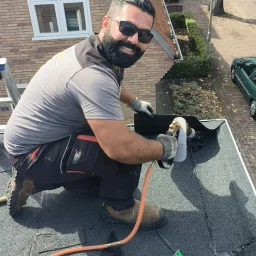
With a worn collar, the old one is removed, the covering around it is cleaned and a new collar or bonding plate is worked in and covered over. That is a targeted job of an hour to half a day, depending on how many penetrations there are.
Penetrations nobody uses any more
Older roofs regularly have a penetration with nothing connected to it any more: an old vent, a pipe from an appliance that has been removed, a cable entry for an aerial that is no longer there. Each of them is still a hole in your roof that has to stay watertight.
During a replacement, that is the moment to remove them and close the roof at that spot. Every penetration you remove is one less leak risk for the coming decades, and with an open roof it costs practically nothing extra.
Frequently asked questions about roof penetrations