EPDM is often presented as the better choice, no strings attached. It is not, and I think you should hear the other side too before you have a roof laid that has to last forty years.
To head off any misunderstanding: I like laying EPDM, and on the right roof it is excellent. But it is not a material that makes itself good.
Five disadvantages at a glance
All joints are handwork. The main area is laid in one piece, but every upstand, corner, penetration and rooflight edge is built up and bonded by hand. On a roof with lots of details, that means lots of manual joints, and that is exactly where flat roofs go wrong.
Repairs need the right material. Damage is easy to repair, but not with whatever is in the van. You need the same type of rubber and the matching adhesive. In fifteen years that is a practical point.
Higher purchase price. EPDM costs more than bitumen. Over its whole lifespan it usually pays for itself, but the investment on day one is higher.
More sensitive to sharp loads. A single rubber membrane is less robust against sharp objects than two layers of bitumen with a mineral top layer. A shifted paving slab or a tool put down on it can cause a cut.
The quality depends entirely on the workmanship. With bitumen you can see from the work whether it was torched properly. With EPDM the quality lies in preparing the substrate and in the bonded seams, and that is invisible after handover.
“With EPDM you are not buying material, you are buying craftsmanship. The main area is easy, the edges decide everything.”
Fouad, owner of Astrodak Service
Why the substrate matters so much
EPDM is fully bonded or mechanically fixed. For bonding, the substrate must be flat, dry and clean. If there is still an old, uneven bitumen layer underneath, or moisture in the build-up, the adhesive does not stick everywhere and over time you get loose patches.
That is why, on an EPDM roof, we almost always remove the old covering rather than working over it. It is more work, and it is the only way to know what you are laying on.
Many penetrations
bitumen
often more practical
Not sure about the right approach?
I would rather come and look at your roof with my colleagues first than come up with a solution from a distance. During the free inspection you hear what is really needed, even if that is less than you thought.
Where EPDM really is the best choice
On a straight roof surface with few details, for example an extension or garage with one outlet and perhaps a rooflight. On a roof you do not want to do again, because the lifespan really is considerably longer. And on a timber roof structure where torching is undesirable, because EPDM goes on without an open flame.
EPDM also has the advantage on a roof you want to make green, because there are no seams in the main area for roots to get through. See
a green roof on a flat roof.
The question that gives the quickest answer
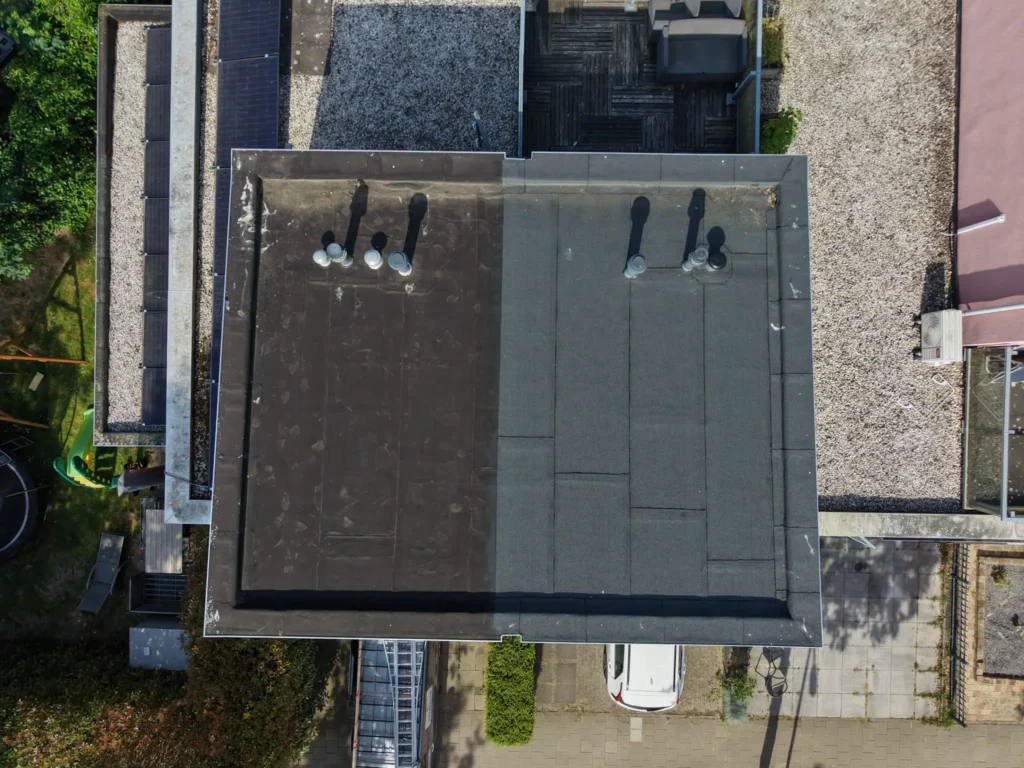
Count how many things stick through your roof: vents, rooflights, cable entries, a chimney, the joint with a dormer. With one or two, EPDM is the logical choice. With six or seven, it becomes bitumen, not because EPDM cannot do it, but because you would be paying for an advantage you do not get.
What you can tell from a finished EPDM roof
Not much, and that is exactly the point. The main area looks smooth and even, and that says nothing about the bond underneath. What you can look at are the edges and joints: are the upstands tight against the wall, is the edge around a penetration neat and even, and is the membrane stuck down everywhere?
A roof where the joints have been made carefully is almost always a roof where the rest has been done well too. The reverse is also true, and that is why at handover I always check the edges, not the middle.
Frequently asked questions about the disadvantages of EPDM