A quote often just says the word bitumen, and that tells you about as much as the word wood. There is a world of difference between the variants, and that difference determines how long your roof lasts.
You don't need to become an expert, but it helps to know what it says. Below are the terms you will come across, in plain language.
APP and SBS: the two main types
APP. Bitumen modified with plastic, making it harder and more resistant to UV and heat. It keeps its shape at high temperatures. Widely used as a top layer on roofs that get a lot of sun.
SBS. Bitumen modified with rubber, so it stays more elastic, even in the cold. It stretches better with movement in the substrate and is less likely to crack at a bend. Often the better choice for timber structures.
In combination. Many roofers use an SBS base layer for elasticity and an APP or SBS top layer for resistance. That is a perfectly good build-up.
Top layer protection. A top layer with mineral slate chippings protects the bitumen against UV. If those chippings disappear, the bitumen underneath ages quickly. Bare patches are therefore not a cosmetic problem.
“Two layers of bitumen is not a luxury. It is the difference between a roof that lasts fifteen years and one that lasts thirty.”
Fouad, owner of Astrodak Service
The number of layers matters more than the brand
If you take one thing away from this article: ask how many layers will be used. A single-layer system is cheaper and lasts considerably less long. With two layers, there is a base layer under the top layer that provides adhesion and forms a second barrier if the top layer is damaged.
On the roof of a house, two layers is the standard you should want. On a small shed roof, one layer can be justified, but then you know what you are getting into.
SBS
more elastic
better in the cold
Not sure about the right approach?
I would rather come and look at your roof with my colleagues first than come up with a solution from a distance. During the free inspection you hear what is really needed, even if that is less than you thought.
Torched, bonded or self-adhesive
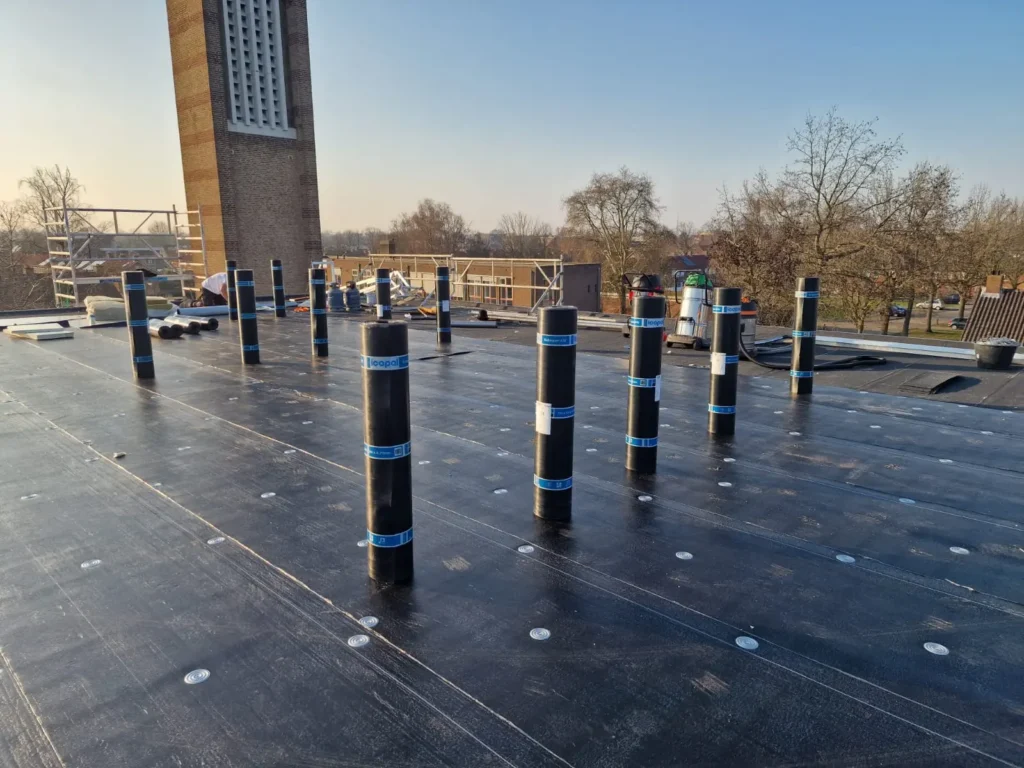
Torching is the classic method: the underside of the roll is melted with a torch and rolled onto the substrate. Strong and quick, but with an open flame, so not desirable everywhere. On a timber structure or close to a facade with vulnerable material, we use a cold system.
Bonding is done with a cold adhesive and is a good solution where torching is not allowed. There are also self-adhesive rolls, mainly as a base layer. In all cases, the substrate must be dry and clean, otherwise nothing will stick.
Where you notice the difference later
Not in the first year, because then all systems look good. You notice it after year ten to fifteen. A single-layer roof then starts to show small cracks at the bends and bare patches in the top layer. A two-layer system with good slate chipping protection is still in perfectly good shape by then.
What you can tell from your current roof
Look at the top layer. If it is covered with mineral slate chippings that are still attached in most places, the protection is intact and the roof still has time. If there are bare patches where the black bitumen is exposed, the UV protection has gone there and it is ageing faster.
Also look at the edges at an upstand. Fine cracks at the bend mean the material has lost its stretch, and that is a property of the bitumen itself, not of the spot. If it starts there, the rest follows within a few years.
Frequently asked questions about types of bitumen