An overflowing gutter seems a minor nuisance: water falls next to it instead of into it. In practice it is one of the most damaging things that can happen to a roof, because the water lands exactly where it shouldn't be.
Down your wall, into your roof base, against your fascia board. And it happens again with every heavy shower.
The four causes
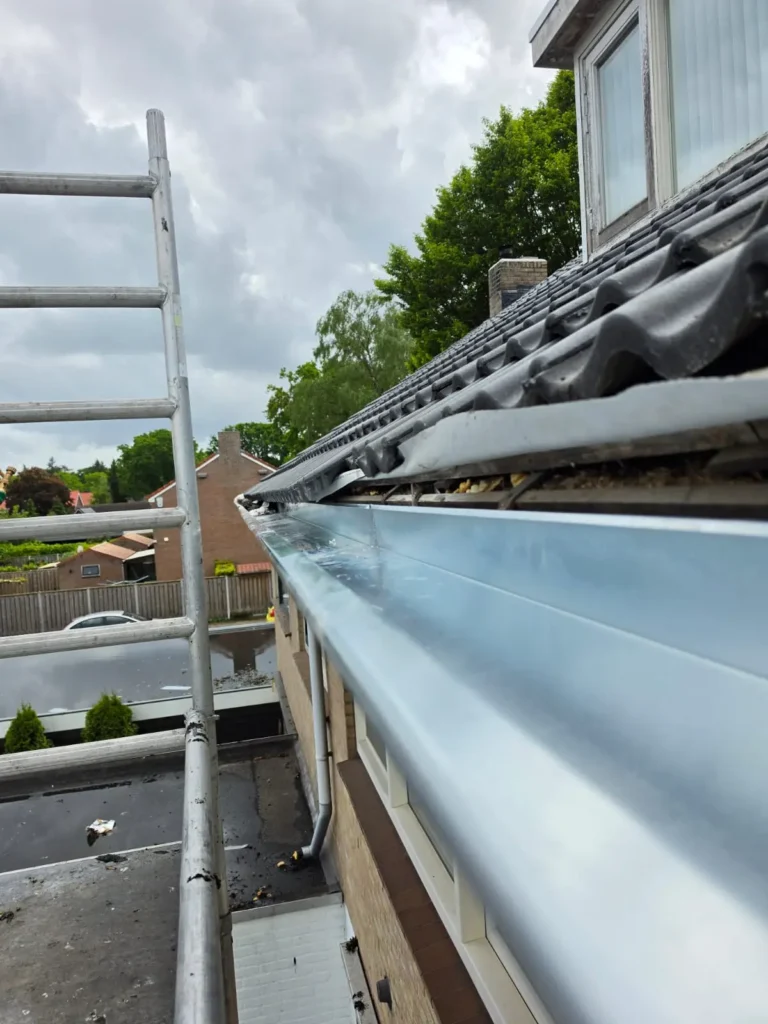
Blockage. The most common. Leaves, moss, roof gravel and sometimes a bird's nest at the outlet. The water rises above the edge and spills over. See
cleaning gutters.
Too little or the wrong fall. A gutter must slope towards the outlet. If it is level or slopes the wrong way, the water stays at one point and spills over the edge there.
A sagging gutter. Loose or bent gutter brackets make the gutter drop in one place. That creates a low point where the water collects.
A downpipe that is too small. With a large roof area on one downpipe, or a downpipe that was sized tightly when the house was built, the gutter simply can't empty fast enough in a heavy downpour.
“Look where the water comes over the edge. That point is the lowest point of your gutter, and it tells you almost everything.”
Fouad, owner of Astrodak Service
How to tell which it is
Go and look during or just after a heavy shower and note where the water comes over the edge. If it is at the outlet, it is almost certainly a blockage or a downpipe that is too small. If it is in the middle of the gutter, far from the outlet, it is the fall or a sagging gutter.
If it overflows along the whole length, the gutter may be blocked along its full length, or the downpipe is completely blocked. You will also notice this because water stays in it for a long time after the shower.
At the outlet
blockage
or a downpipe that is too small
In the middle of the gutter
Have it checked before it becomes a job
Most of the damage I repair was still a small fix a year earlier. Have your roof checked with no obligation and you will know exactly where you stand.
The consequences if you leave it
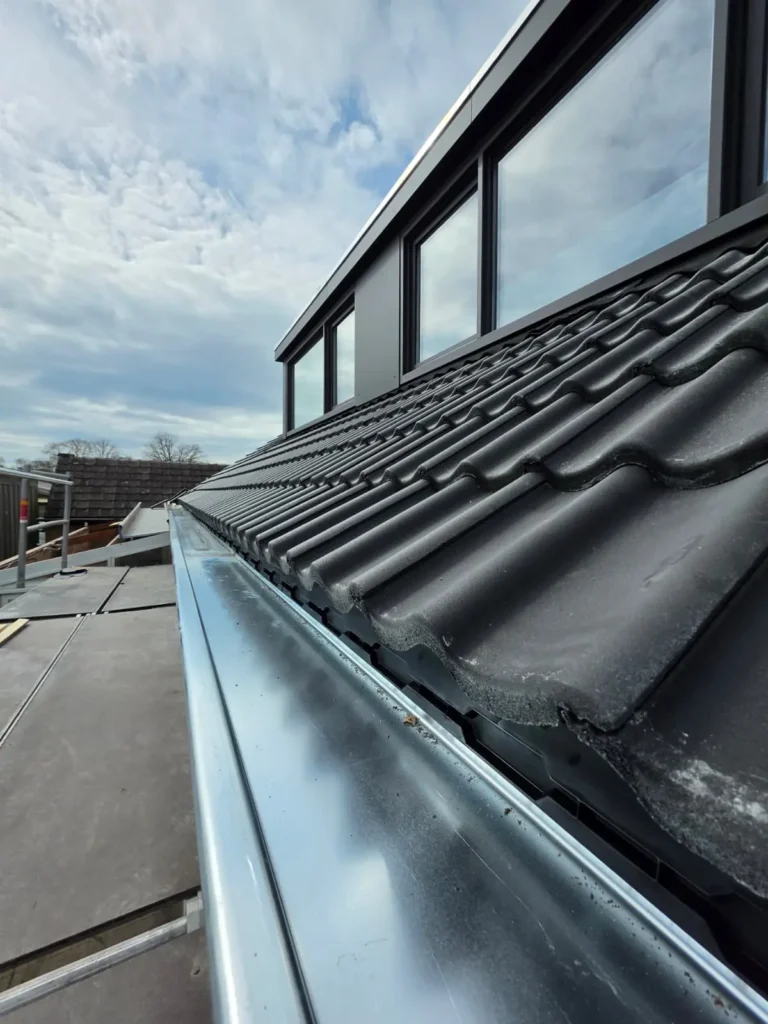
Damp in the roof base. With a box gutter, the excess water goes inwards into the structure instead of outwards. See
the zinc box gutter.
Penetrating damp in the wall. Water that runs down one spot of the wall for years soaks into the brickwork and can cause damp patches inside.
Damage to the gutter itself. Standing water with sludge in it is exactly what wears a zinc gutter through.
What you can do about it
Always start with cleaning, even if you think it is the fall. In a considerable share of cases it turns out to be a blockage after all, and that is the cheapest solution there is. If the gutter is empty and still overflows, it is the fall or the brackets.
Restoring the fall means adjusting or replacing the gutter brackets so the gutter slopes properly again. If the gutter has also worn through, it becomes a replacement, and that is the moment to size the downpipe properly straight away. See
leaf guard or gutter grille and the
page on gutters and maintenance.
What a bucket of water tells you
A test that costs nothing: pour a bucket of water into the gutter at the point furthest from the outlet and see whether it drains away. If it stands, the fall isn't right or the gutter sags. If it drains away but nothing comes out of the downpipe, the downpipe is blocked.
If it simply runs through and comes out at the bottom of the pipe, the gutter is fine and the problem is capacity in heavy downpours. That is a different conversation: it is about the size of the downpipe, not about maintenance.
Frequently asked questions about an overflowing gutter