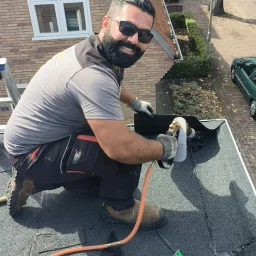
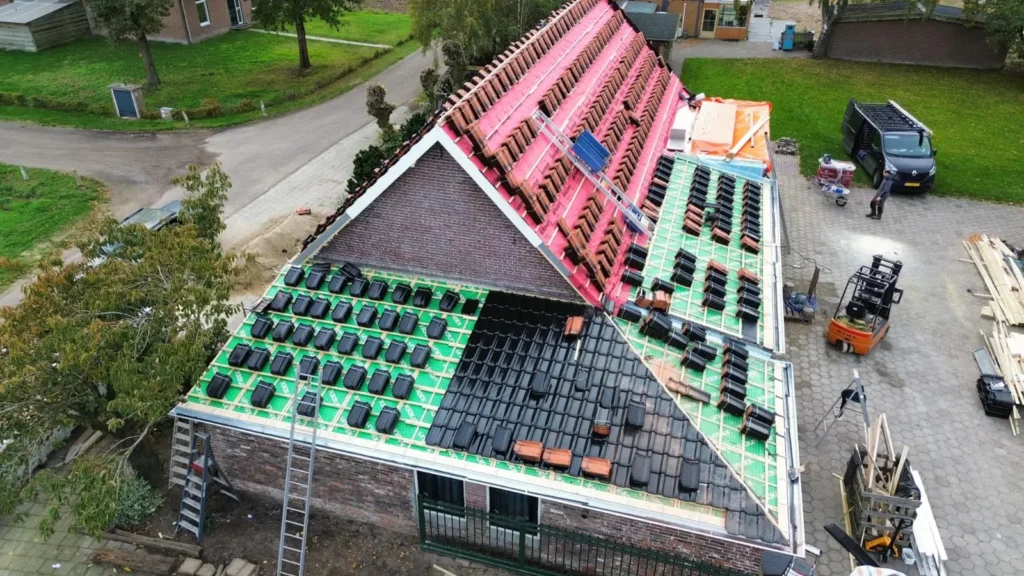
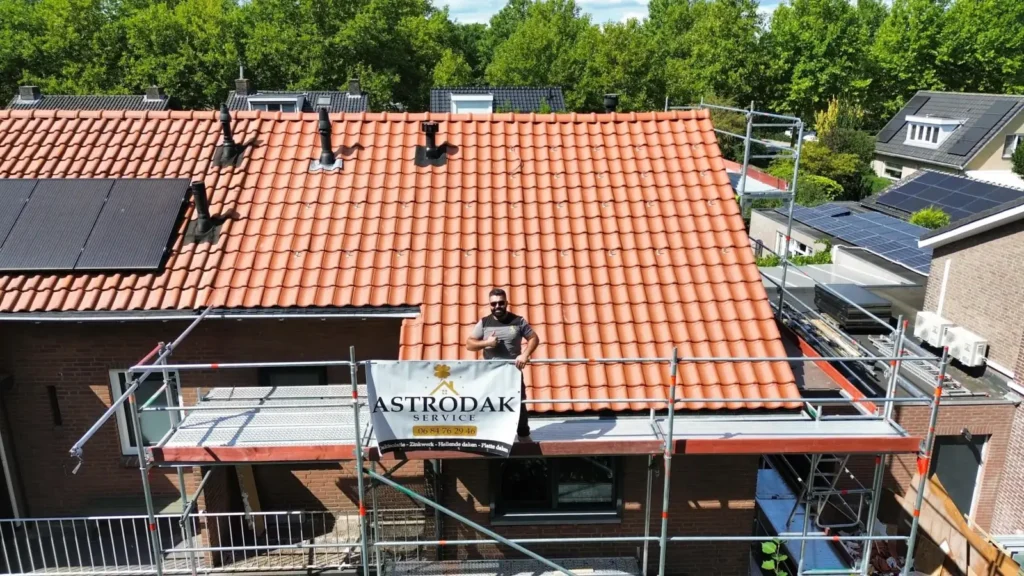
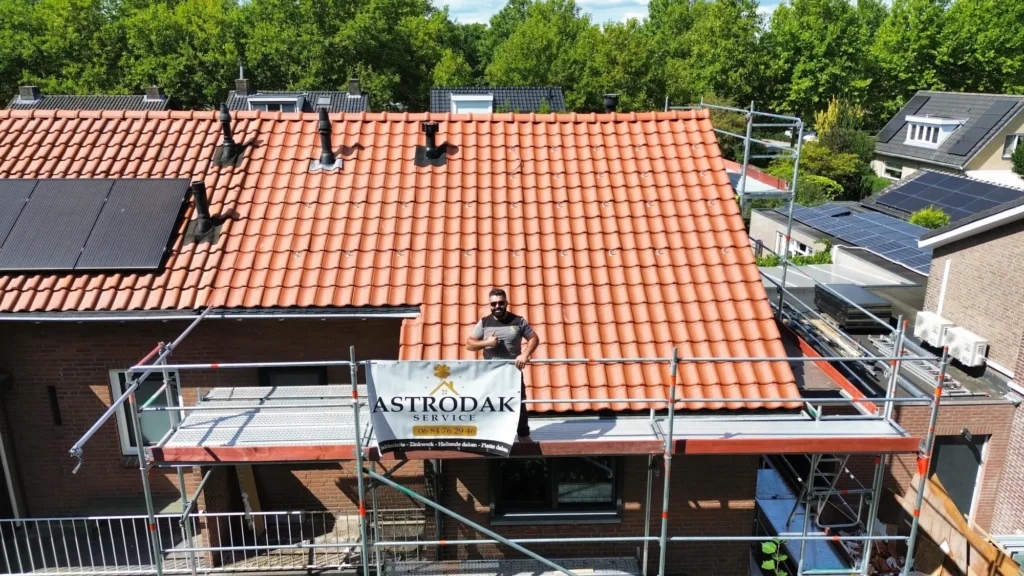
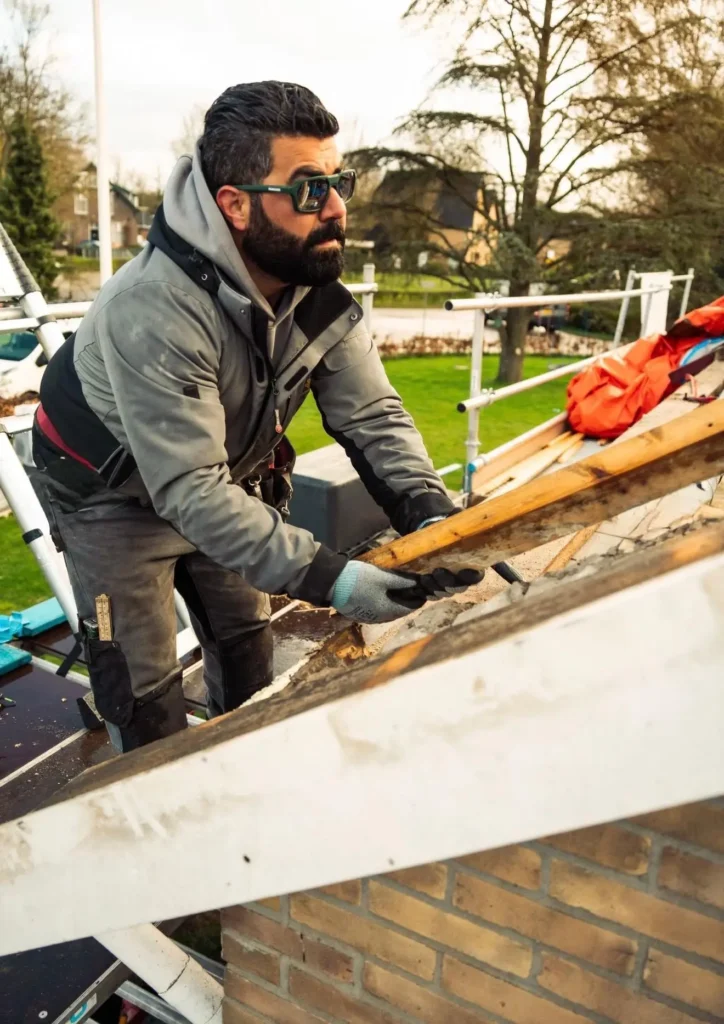
“How long will my roof be open?” That is often the first question, and the answer is usually more reassuring than people think: not a single night. We work one roof slope and one zone at a time, and at the end of every working day the roof is watertight again, either with the new build-up or with a temporary cover.
How long the whole job takes depends on three things: the size of the roof, the delivery time of the material and the weather. In that order of influence.
The process from start to finish
Inspection. I come round with my colleagues, we look at the roof and in the attic and discuss what is needed. Takes about half an hour to an hour.
Quote. Within a few days you receive a detailed quote with a fixed price, the build-up and the lead time.
Planning and material. As soon as you agree, the material is ordered and we schedule the scaffolding. For standard tiles that is quick; for a specific model or colour there may be a delivery time.
The work. Scaffolding, stripping, building up, detailing, clearing up. A repair is a day, a house roof a few days, a large or complex roof longer.
Handover. We go over it together, from the gutter to the ridge, and you get the guarantee in writing.
“Finishing fast is not a mark of quality. Every day we spend on a roof goes into the detailing.”
Fouad, owner of Astrodak Service
What makes the lead time longer
Material delivery time. Standard tiles are in stock. A specific colour, an old model or a made-to-measure zinc gutter takes time.
The scaffolding. Scaffolders work to their own schedule. If the scaffolding stands on public ground, there is a permit process as well.
The weather. In strong wind nobody goes on a roof, and a roof is not opened up in persistent rain. That is why we plan with some margin.
Extra work. If the roof boarding turns out worse than expected, extra timber and an extra day of work are added. See
avoiding extra work.
Not sure about the right approach?
I would rather come and look at your roof with my colleagues first than come up with a solution from a distance. During the free inspection you hear what is really needed, even if that is less than you thought.
The best time of year
Roof work can be done all year round, with a few practical exceptions. In frost, mortar cannot be laid, so ridge work in mortar gets postponed. A reason to
use a dry fix. Torching bitumen in damp cold is unwise, and in strong wind everything stops.
Spring and late summer are the calmest months for weather and the busiest for scheduling. If you want the work finished before winter, it is smart to start planning in late spring. None of this applies to an
emergency: then we come the same day and make the roof watertight first.
What a working day on your roof looks like
We start early, usually around seven, because roof work is most pleasant in the morning and we want to keep the warmest part of the day for lighter work. The first step is always to cordon off and protect: the pavement, the drive, the plants along the wall.
After that, we never open up more roof than we can close again that same day. That is the most important rule on a roof, and the reason stripping a roof goes more slowly than you might expect. At the end of the day we clear up: rubble in the skip, no tiles in the garden, no nails on the drive.
And if the weather turns while we are working, we close the roof and wait. That sometimes costs half a day of the schedule, but the alternative is water in your house.
What you can prepare yourself
Not much, and that is the idea. What helps: a clear spot for the skip and the scaffolding, moving things in the attic away from under the roof slope being worked on, and a quick message to the neighbours, because stripping a roof is not quiet. We move delicate plants by the wall together.
Why a roofer plans with a margin
Roof work is outdoor work and so depends on the weather. Anyone who plans a job to the day without any slack has to keep working in the rain or leave the roof open, and neither is acceptable. That is why we plan with a margin and do not start a job if the forecast for the first few days is bad.
That sometimes means we start later than you would like. In return the roof stays closed, the membrane is laid on a dry surface and no bitumen goes onto a damp surface, because that last one comes back in five years as blistering.
Frequently asked questions about planning and lead time