A roof is the only part of your house that you only really see once it is off. Until then, everyone, me included, looks at the outside and at what can be seen from inside in the attic. That gives a good picture, but not a complete one.
That is why some extra work on a roof renovation is not unusual. What is unusual: it coming as a surprise. That is a conversation that should have taken place before the job.
Four sources of extra work
Roof boarding. The wood under the tiles may have gone soft in places, often around the chimney, at the valley gutter and at the eaves. You cannot see that from outside; from inside you sometimes can, from water rings on the wood.
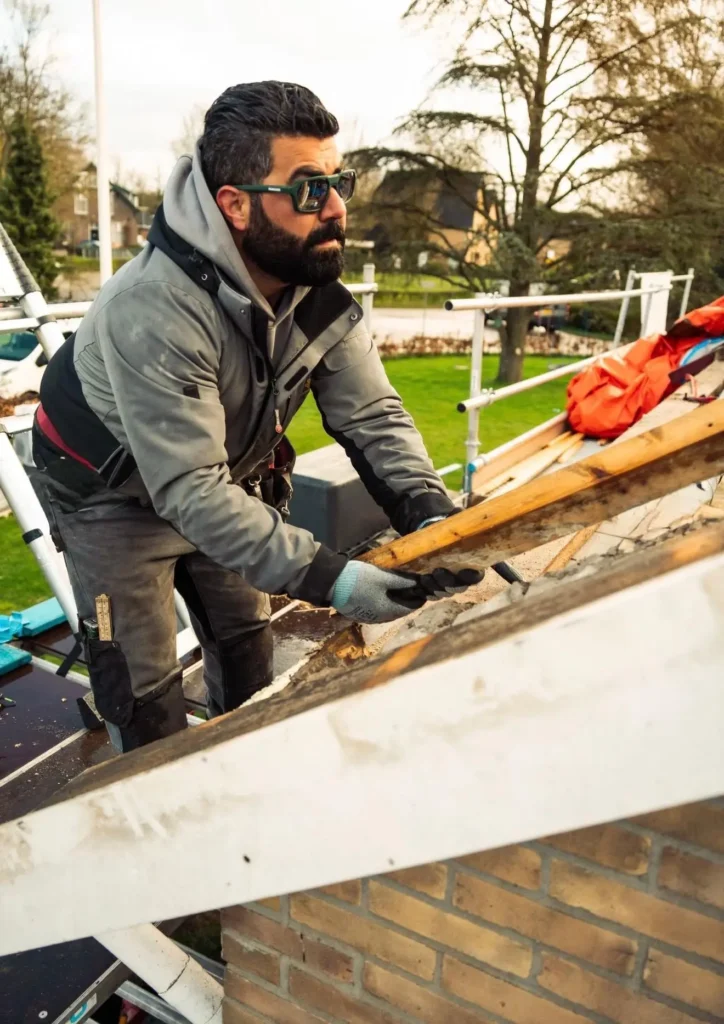
Timber at the gutter. Under a gutter that has leaked for years, there is often a decayed fascia board or gutter board. That only comes to light once the old gutter is off. See
fascia boards and roof edge trim.
Asbestos. In old underlays, corrugated sheets and sometimes in chimney flues. Removal is bound by rules and is not something you just take care of along the way. See
recognising asbestos.
The structure. Sagging rafters, a sunken ridge, a wall plate that has rotted away. This is structural work and falls outside normal roofing work.
“I cannot guarantee that nothing will turn up. What I can do is say in advance what happens if it does.”
Fouad, owner of Astrodak Service
How to agree on it in advance
There are three agreements that take away most of the worry, and they cost nothing to make.
Name the risk in the quote. Not in the small print, but as a sentence that says: these are the places where it could go either way, and this is the unit price if it turns out worse.
Agree that you are called first. No work that is not in the quote without your permission. With us, I send a photo of what I find before anything is done.
Ask for a unit price, not an estimate. For example a price per sheet of roof boarding or per metre of fascia board. Then extra work is arithmetic instead of negotiation.
The places where it almost always is
Extra work rarely comes from the middle of a roof slope. It is in the places where water collects or where two materials meet. Four places I always check separately before I give a price.
Around the chimney. Water that creeps in past poor lead disappears into the roof boarding right next to the chimney. From outside you see nothing, from inside a faint ring.
In and under the valley gutter. Where two roof slopes meet, all the water comes together. A valley gutter that is too narrow or full of leaf sludge lets the wood underneath rot.
At the eaves. Where the membrane runs into the gutter. If it does not run through properly, the bottom section of roof boarding and the fascia board stay wet for years.
At roof windows and penetrations. Every interruption is a detail that was made at some point and has aged at some point. See also
leaks at a dormer.
What a good inspection can rule out
A lot. In the attic, the wood shows where moisture has been. On the outside, I can tell from the position of the tiles and the ridge whether the battens are still doing their job. At the gutter and fascia board I can see whether the wood underneath has been wet for years. And from the year of construction plus the build-up, I can usually judge whether asbestos is to be expected.
That is exactly why I come round with my colleagues instead of quoting a price from a distance. Half an hour of looking makes the difference between a fixed price and an estimate. Also read
what a good quote contains.
Want to know what your roof will cost?
A price per m² is a guideline, not a quote. I come round with my colleagues, we measure the roof, look at the structure and then send a quote with a fixed price. The inspection is free and puts you under no obligation.
And if it turns out worse?
Then you hear about it on the day it comes to light, with a photo and a price. Not on the final invoice. That is not a special service, that is how it should be. Do you live in Vught,
Den Bosch,
Boxtel or the surrounding area and would you simply like to know where you stand first? Request a
free roof inspection.
The difference between extra work and a poor estimate
Extra work is work that nobody could have known about in advance, for example roof boarding that only becomes visible once the roof is open. A poor estimate is work that could have been foreseen but was not in the quote. That distinction matters, because the first is part of the job and the second is not.
You can tell the difference by whether the risk was named in advance. If the quote states that the roof boarding at the chimney is a risk area, with a price per sheet, then extra work there is an agreement. If it is not stated and a bill is added during the job anyway, the estimate was not complete.
Frequently asked questions about extra work