Of all the damp problems in an attic, this is the most underestimated. Someone calls about a leak, we come to look, and the roof is completely fine. The moisture does not come from outside but from inside: from the laundry, from the bathroom, from the people in the house.
Warm air holds moisture. When that air touches a cold surface, it releases that moisture. In an attic with little or no insulation, the underside of the roof is exactly that cold surface.
Five differences you can see for yourself
The timing. Condensation is worst on cold days and in the morning, even when it is bone dry outside. A leak follows the rain. This is the quickest way to tell them apart.
The spread. Condensation produces many small droplets or an even film of moisture over a large area, often over the whole underside of the roof slope. A leak produces one trail or one stain.
The location. Condensation likes the coldest spots: at the eaves, in the corners, on nail points and on metal parts. A leak follows the structure downwards.
The trail. With a leak, a trail runs upwards to a source you can point to. With condensation there is no source, only a surface.
The smell. Condensation that lingers gives a musty smell and white or grey-green mould on timber. A leak tends to give a wet, earthy smell.
“If the moisture is there while it is dry outside, you do not need to call a roofer. You need more air.”
Fouad, owner of Astrodak Service
Why condensation appears precisely after insulating
This is the annoying variant. Someone insulates an attic from the inside, and a year later there is moisture in the structure. Almost always because the vapour control layer has not been sealed airtight or is missing.
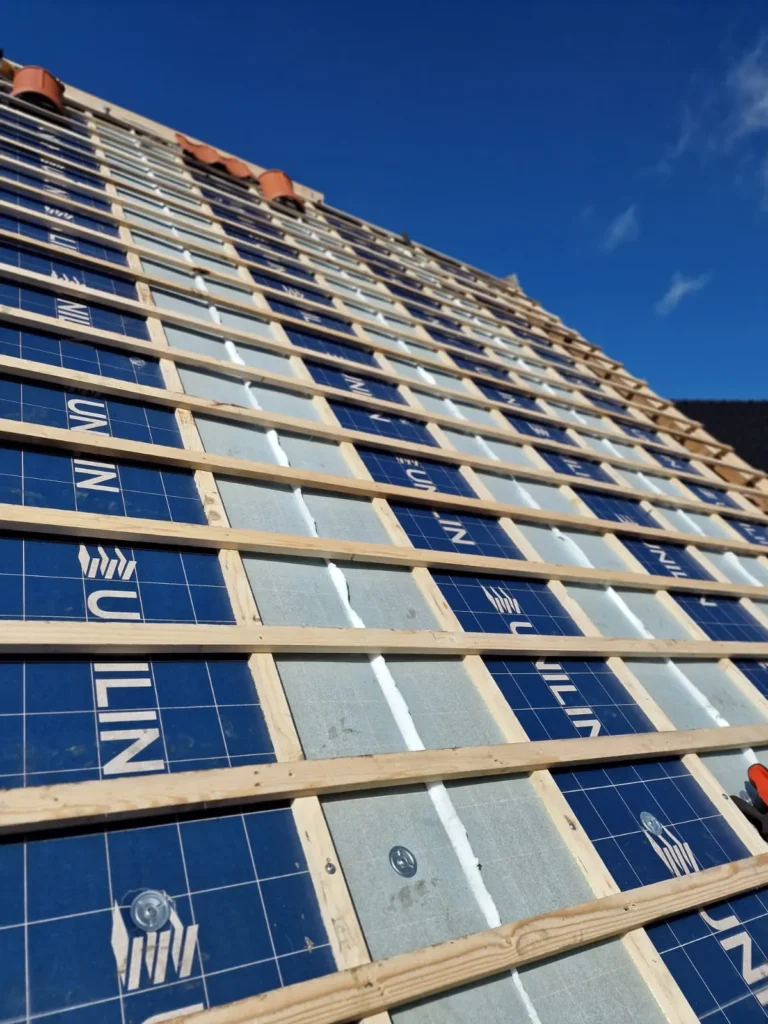
What happens then: warm, moist indoor air gets through gaps in the insulation, cools against the cold roof boarding and condenses there. In a place you cannot reach and where it cannot dry out. That is why we pay so much attention to the membrane when insulating, see
the vapour control layer and
insulation and ventilation.
Not sure about the right approach?
I would rather come and look at your roof with my colleagues first than come up with a solution from a distance. During the free inspection you hear what is really needed, even if that is less than you thought.
What to do about condensation
Make sure air can flow. An attic needs air movement. The ventilation openings at the eaves are often blocked with insulation or closed off with bird guards that let no air through.
Remove the source of moisture. Drying laundry in the attic is the most common cause I come across. A bathroom without a good extractor also sends its moisture to the highest space.
Keep the hatch closed. An open attic hatch lets warm, moist air from the house flow into the coldest space. That is exactly the recipe for condensation.
Have the membrane checked. With an insulated roof, condensation is almost always an airtightness problem. That is a job for a professional.
And if it turns out to be a leak after all
That is possible, because the two do not rule each other out. A small leak that keeps the roof boarding damp also makes condensation more likely, because damp timber feels colder and stays wet longer. So when in doubt, I always check both: first the trail, as in
tracing a leak, and then the ventilation.
The test with a piece of plastic
If you are unsure whether moisture comes from outside or inside, there is a simple test. Tape a piece of clear plastic tightly against the underside of the roof boarding at the suspect spot, and leave it for a few days. If moisture appears on the room side of the plastic, it comes from the indoor air and it is condensation.
If the moisture appears between the plastic and the timber, it comes from outside and it is a leak. It is not a laboratory method, but in practice it works surprisingly well, and it costs you a piece of plastic sheet and some tape.
Frequently asked questions about condensation in the attic