On a warm day there is suddenly a bulge in your flat roof, sometimes as big as a football. It looks wrong and immediately raises the question of whether the roof is about to leak.
The answer depends on what is inside the blister. And you can largely work that out yourself with a simple test.
Where a blister comes from
Under the roofing there is a tiny amount of air or moisture, trapped during laying or which got in later. In the heat, that air expands and the moisture evaporates. Because the covering is not stuck to the substrate at that spot, it lifts and forms a blister.
In the evening everything cools down and the blister sinks back, fully or partly. That going up and down, day after day, is exactly what wears out the covering at that spot.
When it is nothing to worry about and when it is
Small and hard. A few small blisters that feel firm and don't grow are usually air trapped during laying. Annoying, but not a leak in the making.
Soft and springy. If the blister feels like a water bag, there is moisture in it. That is a sign that water is getting under the covering or that the build-up is damp.
Growing in number. If more blisters appear every year, the covering is coming loose in more places. Then the adhesion is the problem, not a single trapped bubble.
On the seams or at an upstand. Blisters right on a seam or at the bend of an upstand are the most suspicious, because that is also where the weak point of the roof is.
“Never puncture a blister. You swap a bulge for a hole, and a hole is a leak.”
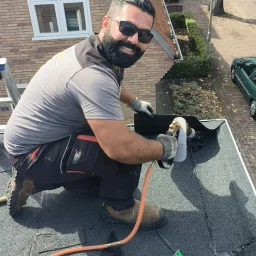
Fouad, owner of Astrodak Service
Not sure about the right approach?
I would rather come and look at your roof with my colleagues first than come up with a solution from a distance. During the free inspection you hear what is really needed, even if that is less than you thought.
What you should not do
Puncture it. That is the first instinct and the worst thing you can do. At that moment a blister is still watertight. As soon as you make a hole in it, it no longer is, and the moisture you wanted to let out now goes the other way.
Also don't: put something heavy on it to keep it flat. The covering is not attached there, so you only press it back temporarily and increase the tension on the edge of the blister.
What a roofer does about it
With a single blister on an otherwise healthy roof, the spot is cut open in a cross, dried, laid back and covered with a new piece of bitumen. That is a targeted repair of an hour, and then it is done.
If there are many blisters, or if cutting it open shows that the insulation underneath is damp, it is a different story. Then the blister is a symptom of a build-up that has taken on water, and just sealing it makes no sense. See
wet insulation after a leak.
How to prevent blisters on a new roof
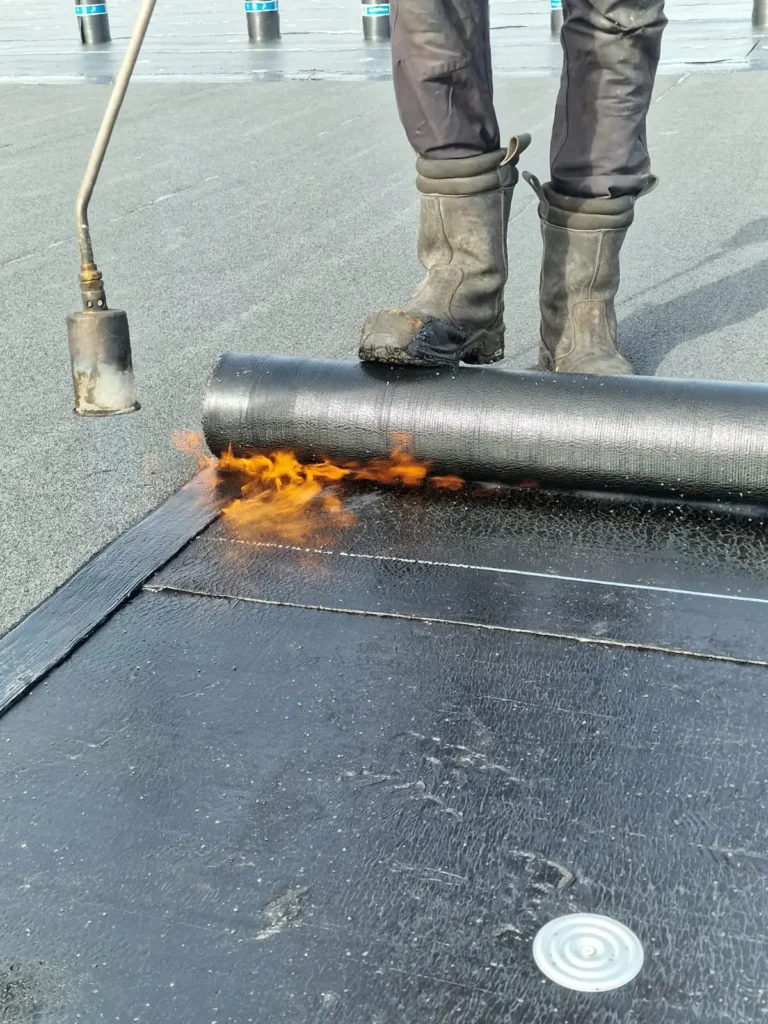
Mainly through a dry, clean substrate. Bitumen torched onto a slightly damp substrate traps the moisture, and that comes out again later as a blister. That is why we don't lay roofing on a day when it can't be got dry, even if that costs a day in the schedule.
How a blister should be repaired
Not by flattening it or puncturing it, but by cutting the spot open in a cross, folding back the four flaps, drying the substrate and bonding the flaps down again. Then a new piece of bitumen goes over it, well beyond the edge of the old blister.
That is a repair of an hour, and then it is done. What you want to check is whether the roofer actually dried the spot before sealing it, because repairing a blister with moisture underneath gives you the same blister a year later.
Frequently asked questions about blisters in roofing